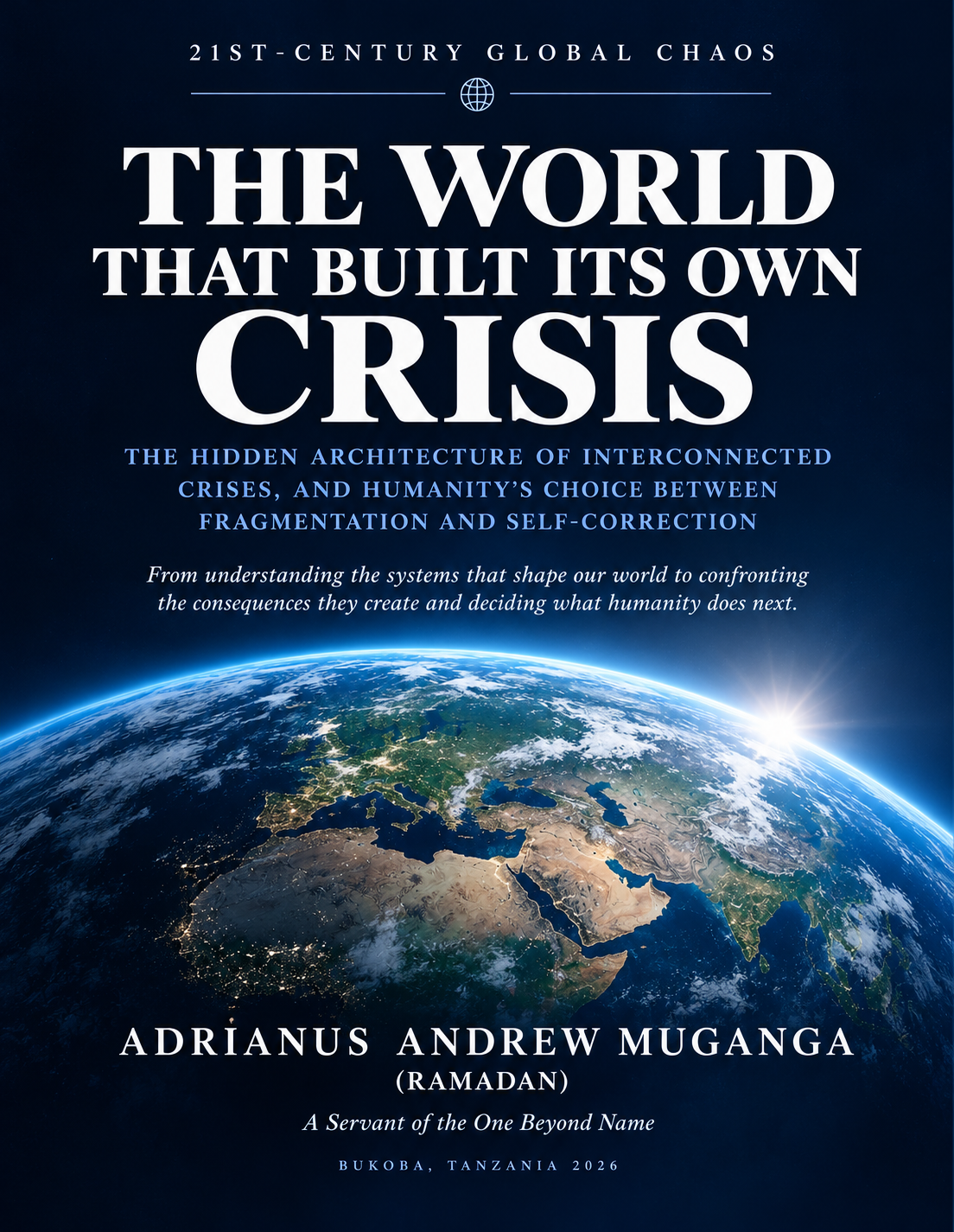
The World That Built Its Own Crisis
21st-Century Global Chaos: The Hidden Architecture of Interconnected Crises, and Humanity’s Choice Between Fragmentation and Self-Correction
The World That Built Its Own Crisis examines one of the defining questions of the twenty-first century: how can a world that has achieved extraordinary advances in science, technology, economic production, communication, and institutional organization continue to experience persistent instability, inequality, environmental degradation, conflict, and uncertainty about its future?
The book argues that many contemporary global challenges cannot be adequately understood as isolated events. They emerge within interconnected systems shaped by history, economic arrangements, political institutions, technological development, social relationships, and ecological conditions. These systems have created remarkable opportunities for human advancement, but their interactions can also generate vulnerabilities, unintended consequences, and failures that extend beyond the intentions of individual decision-makers.
The central concern of the book is not simply that humanity faces multiple crises, but that the systems responsible for organizing modern civilization can sometimes reproduce or intensify the problems they are expected to solve. Understanding this condition requires looking beyond visible symptoms to investigate the structures, incentives, dependencies, and relationships that influence outcomes.
The investigation begins with everyday human experience. Economic insecurity, rising living costs, limited access to essential services, environmental pressures, employment difficulties, and declining confidence in institutions are not merely abstract indicators. They affect livelihoods, opportunities, dignity, and people's ability to plan for the future. The book uses these experiences as starting points for examining wider forces that shape conditions across communities, countries, and international networks.
A major theme is the relationship between local problems and global systems. The location where a difficulty becomes visible may not be the location where its causes originate. Changes in international markets, energy supply, transportation, financial conditions, technology, or geopolitical relationships can influence circumstances elsewhere. However, these effects are not uniform. National institutions, infrastructure, local markets, historical circumstances, and the distribution of resources influence how external pressures are transmitted and experienced. The book therefore emphasizes tracing causal relationships carefully rather than assuming that every local difficulty has one universal explanation.
Historical development provides another essential foundation. Modern civilization has been shaped by the expansion of political authority, industrial production, international trade, financial systems, scientific knowledge, communication networks, and digital technologies. These developments have increased humanity's capacity to organize activity across geographical boundaries. They have also created dependencies between institutions, populations, resources, and infrastructures. The same connections that support cooperation and prosperity can transmit disruption when essential systems become vulnerable or when the consequences of decisions are inadequately considered.
The book explores the global condition through several interconnected areas of pressure, including geopolitics, economic instability, social inequality, environmental degradation, energy security, technological transformation, information disorder, and institutional trust. It does not present these subjects as identical or suggest that they share one simple cause. Instead, it investigates how particular mechanisms can connect them. Economic insecurity may weaken public confidence; declining trust may obstruct collective action; environmental pressures may affect food systems and livelihoods; technological change may redistribute opportunities and risks; and geopolitical rivalry may complicate cooperation on problems that cross national borders.
Systems thinking provides the principal analytical approach. The book distinguishes observable events from the underlying structures that may help produce them. It examines feedback loops, incentives, institutional arrangements, resource dependencies, system boundaries, and the distribution of costs and benefits. It also considers how an intervention that improves one part of a system may create new pressures elsewhere. A policy may provide immediate relief without addressing the conditions that repeatedly generate hardship, while an organization may improve its own performance by transferring costs to workers, communities, other institutions, or the environment.
This approach does not assume that every crisis has a hidden common cause or that interconnectedness automatically produces failure. Rather, it calls for specific explanations supported by evidence, logical consistency, relevant comparisons, and attention to alternative interpretations. The book emphasizes the importance of distinguishing established facts from explanations, hypotheses, broader syntheses, and value judgments. It recognizes that complex systems contain uncertainty and that credible conclusions must remain open to criticism, new evidence, and revision.
The analysis then considers the possible directions of humanity's future. Three broad scenarios structure this examination: fragmentation and escalation, partial adaptation, and coordinated self-correction. Fragmentation describes conditions under which geopolitical rivalry, economic insecurity, environmental pressures, information disorder, and institutional distrust reinforce one another. Partial adaptation represents a future in which societies make meaningful progress in selected areas while deeper structural weaknesses remain unresolved. Coordinated self-correction explores the conditions under which institutions and societies could learn from failure, strengthen cooperation, improve accountability, and align decisions more closely with long-term social and ecological well-being.
These scenarios are not presented as fixed predictions. The future depends on interacting conditions, uncertain developments, institutional choices, available resources, and human decisions. Different regions and communities may experience different combinations of these possibilities. By examining warning indicators, structural vulnerabilities, and opportunities for intervention, the book encourages readers to consider how present decisions can influence future outcomes without claiming that any single scenario is inevitable.
The final movement of the book shifts from diagnosis toward the practical requirements of self-correction. Awareness alone does not guarantee change. Effective action requires identifying root causes, establishing clear objectives, selecting appropriate interventions, assigning responsibilities, providing resources, measuring results, and revising strategies when evidence demonstrates that they are ineffective or harmful. Incentives must encourage responsible conduct, institutions must learn from mistakes, and decision-makers must be answerable for the consequences of their actions.
Resilience and regeneration are equally important. A society cannot secure its future merely by surviving disruption or restoring activity to its previous level. It must also preserve and renew the ecological, material, social, and institutional foundations on which human well-being depends. This requires attention to resource limits, essential services, infrastructure, environmental protection, unequal exposure to risk, and the capacity of communities to recover without reproducing the vulnerabilities that made earlier disruptions damaging.
Cooperation is another central requirement, particularly in a world where power, resources, knowledge, and decision-making capacity are unevenly distributed. Shared challenges require coordination, but effective cooperation must also recognize differences in circumstances, responsibilities, and vulnerability. Technology must be governed with attention to its benefits, risks, accessibility, and concentration of power. Information must remain open to scrutiny, public institutions must demonstrate accountability, and policies must be evaluated according to their actual consequences rather than their stated intentions.
Ultimately, The World That Built Its Own Crisis is an inquiry into the relationship between human achievement, systemic vulnerability, and responsibility for the future. It does not offer a promise of perfect solutions or claim that civilization follows a predetermined path toward either collapse or progress. Instead, it argues that meaningful improvement depends on humanity's willingness to understand the systems it has created, recognize their limitations, confront uncomfortable evidence, and change arrangements that repeatedly produce avoidable harm.
The book invites researchers, students, policymakers, institutional leaders, and concerned readers to move beyond fragmented explanations of global events and examine the relationships that shape the human condition. Its central message is that knowledge becomes valuable when it improves judgment, accountability makes power more responsible, and resilience becomes meaningful when it protects the foundations of life and human development.
The future remains open to influence, but not through hope or ambition alone. It requires informed choices, credible evidence, institutional learning, collective responsibility, and sustained action. Humanity's challenge is therefore not simply to build more powerful systems, but to develop the capacity to understand, govern, and correct them.
The defining question is whether civilization can learn from the consequences of its own development and transform interconnected vulnerability into a foundation for more responsible, resilient, and sustainable progress.
#Interconnected Global Crises
#Systems Thinking
#Civilization
#Global Governance
#Economic Instability