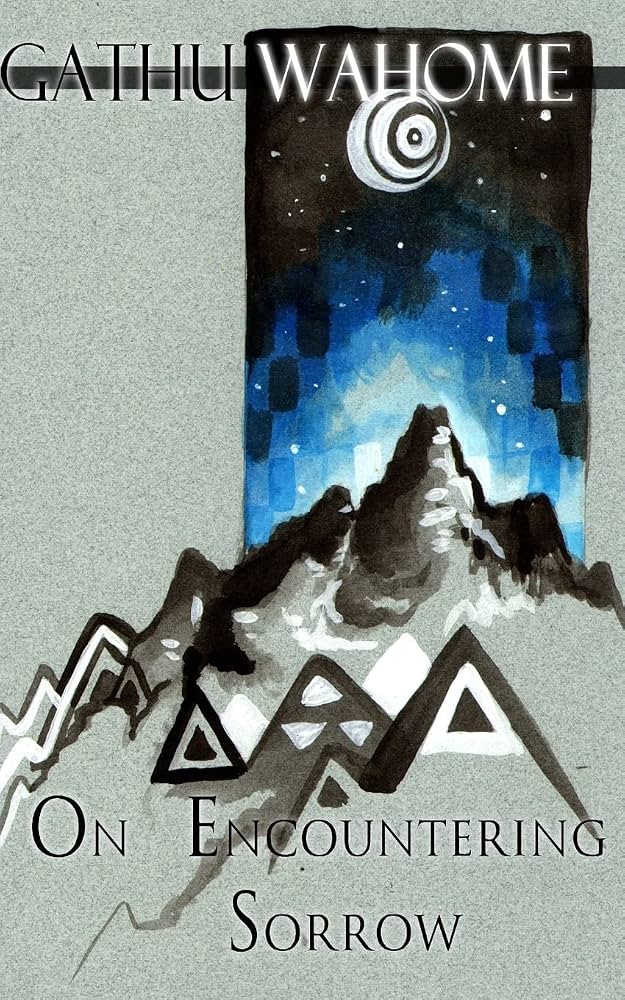
On Encountering Sorrow is an ambitious, intellectually engaging, and emotionally resonant collection of poetry that establishes Gathu Wahome as a distinctive contemporary Kenyan voice. Rooted in history, memory, love, social justice, and indigenous identity, the collection transcends conventional poetry by integrating literary criticism, stylistic analysis, bilingual presentation, and pedagogical materials, making it equally valuable as a creative work and an educational resource.
The 528 pages of the anthology moves confidently between deeply personal reflections and sweeping historical narratives. Poems such as Facing the Hill capture the quiet anguish of separation, longing, and emotional isolation through vivid sensory imagery and carefully sustained lyricism.
The accompanying literary analysis demonstrates how metaphor, personification, hyperbole, imagery, alliteration, rhetorical questions, and symbolism contribute to meaning, allowing readers not only to appreciate the poem emotionally but also to understand the craftsmanship behind its composition. By including questions for primary, secondary, and university learners, the collection transforms poetry into a practical teaching resource suitable for classrooms across multiple educational levels.
History occupies a central place throughout the anthology. Poems such as Fateful Day, General Ebei 1900, Criminals, and Comradeship (Nyũmba na Rika!) revisit anti-colonial struggles, revolutionary movements, political betrayal, corruption, and the continuing search for justice.
Wahome writes from a perspective deeply conscious of Kenya's liberation history while situating it within broader African and global struggles against oppression. His historical poems do not merely commemorate the past; they interrogate the present, challenging readers to reflect on governance, inequality, and civic responsibility.
Alongside political engagement, the collection reveals remarkable emotional depth. Few Texts offers a moving portrait of unemployment, social isolation, poverty, and silent humiliation. The poem speaks directly to the realities confronting many young people in contemporary Kenya, whose aspirations are often frustrated by economic hardship and social exclusion. Likewise, Facing the Hill demonstrates the poet's ability to translate private grief into universally recognizable human experience, making longing itself a powerful poetic subject.
One of the anthology's greatest strengths is its celebration of indigenous language and culture. Several poems are presented in Gĩkũyũ alongside English translations, including Kĩhoto (New Heroes) and Ihinda (Season). Rather than treating African languages as peripheral, the collection positions them as sophisticated literary mediums capable of expressing philosophy, history, resistance, spirituality, and aesthetic beauty. The bilingual presentation broadens accessibility while preserving the cultural authenticity and musicality of the original texts.
Stylistically, Wahome draws heavily from African oral traditions while employing modern poetic techniques. Symbolism, repetition, parallelism, rhetorical questions, personification, vivid imagery, metaphor, and historical allusion recur throughout the collection, producing poetry that is at once lyrical, performative, and intellectually provocative. His language is often direct and uncompromising, particularly in poems addressing colonial violence, corruption, and political oppression, yet he balances this intensity with reflective pieces that explore love, loneliness, nostalgia, and resilience.
Perhaps the collection's most innovative contribution lies in its educational design. By pairing selected poems with detailed stylistic analyses and comprehension exercises tailored for primary, secondary, and university students, On Encountering Sorrow bridges the gap between creative literature and literary scholarship. Students are encouraged not only to read poems but also to analyze structure, symbolism, figurative language, thematic development, and social relevance. This pedagogical approach makes the volume exceptionally valuable for teachers, lecturers, curriculum developers, and literature students.
Thematically, the anthology explores recurring questions that have shaped African literature for generations: How should societies remember their heroes? What responsibilities accompany freedom? How does language preserve identity? What becomes of those left behind by history or economic change? How do love, memory, and hope survive amid suffering? Rather than offering simplistic answers, Wahome invites readers into sustained reflection.
The collection's title, On Encountering Sorrow, aptly captures its emotional landscape. Yet sorrow is never presented as defeat. Instead, suffering becomes a catalyst for remembrance, resistance, reconciliation, renewal, and hope. Whether recounting the heroism of General Ebei, the loneliness of unemployment, the ache of separated lovers, or the resilience embedded in indigenous culture, the poems consistently affirm the enduring capacity of human beings to persevere through adversity.
More than a poetry anthology, On Encountering Sorrow is a literary archive of memory, identity, history, and resilience. It successfully combines creative artistry with literary criticism and educational practice, making it suitable for general readers, scholars, schools, colleges, and universities alike. Gathu Wahome demonstrates that poetry can simultaneously preserve cultural heritage, interrogate political realities, nurture emotional understanding, and cultivate critical thinking.
This collection stands as an important contribution to contemporary Kenyan literature and deserves a place among works that seek not only to move readers emotionally but also to educate, challenge, and inspire them. It is a volume that rewards repeated reading, revealing new layers of meaning with each encounter.
Get your copy now!
gathuwahome@gmail.com
0717504444
#Love
#Kenya
#Money
#Liberation
#Scholarship