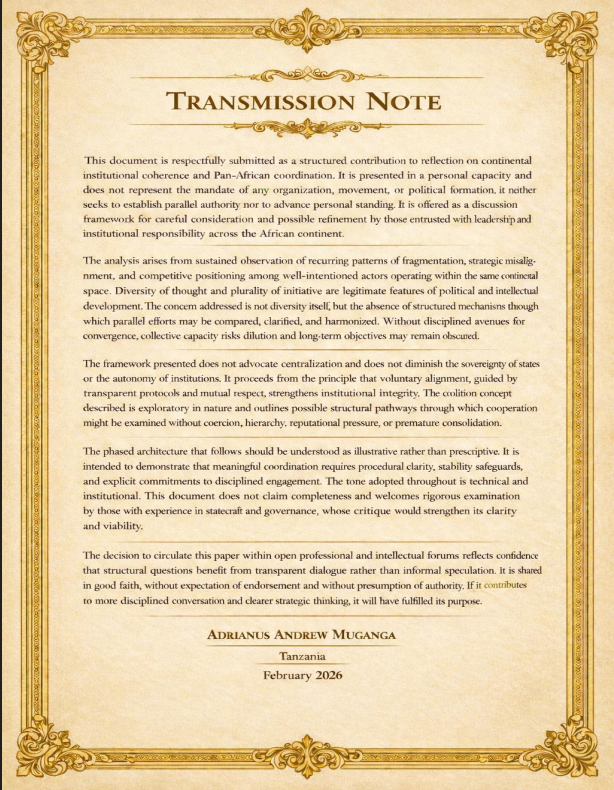
Pan-African Institutional Alignment Framework – Phase I: Awakening (2026–2027). Pan-African Institutional Alignment Framework – Phase I: Awakening (2026–2027) is a governance and institutional development work that addresses one of the most significant structural challenges facing contemporary Pan-Africanism: fragmentation among organizations, movements, intellectual platforms, and advocacy initiatives pursuing continental integration. Rather than proposing immediate political unification or institutional redesign, the framework argues that meaningful continental advancement requires a prior stage of alignment, coordination, and conceptual clarity. The document presents Phase I, known as Awakening, as a preparatory process designed to transform dispersed aspirations into organized capacity.
The framework begins with the observation that numerous Pan-African organizations and schools of thought currently exist across Africa and the diaspora. These include advocates of federal integration, confederation models, African Union reform, regional integration strategies, coordinated sovereignty approaches, and other institutional visions. While these initiatives often share similar long-term objectives, they frequently operate independently, employ different terminology, and pursue different sequencing strategies. As a result, diversity of perspective is often perceived as division rather than complementarity.
The central argument of the document is that fragmentation weakens influence. Fragmentation does not necessarily eliminate progress, but it reduces leverage, complicates communication, increases misunderstanding, and limits collective bargaining power. Historical experience demonstrates that successful institutional transformations generally emerge from coalition-building, structured consultation, and coordinated positioning. Where alignment mechanisms are absent, organizations may unintentionally compete with one another despite pursuing related goals.
The framework emphasizes that the challenge is procedural rather than ideological. The problem is not the existence of multiple visions for Africa’s future. The problem is the absence of a recognized mechanism through which those visions can be compared, clarified, harmonized, and coordinated. The purpose of Phase I is therefore not to determine which model is correct but to establish the conditions under which meaningful dialogue and alignment can occur.
A key section of the document examines the consequences of fragmentation. The author argues that institutional influence is directly related to the degree of coordination among actors pursuing similar objectives. Examples from African institutional history demonstrate that significant continental achievements have generally emerged through coalition-based processes. The transition from the Organization of African Unity to the African Union, as well as the negotiation of the African Continental Free Trade Area, required extensive consultation and consensus-building among diverse actors. These examples illustrate that large-scale transformation depends upon coordinated positioning rather than isolated initiatives.
The framework also highlights how fragmentation can reduce diplomatic leverage during moments of crisis. When actors present divergent positions or fail to coordinate effectively, their collective capacity to influence events diminishes. External partners often prefer engaging with structured entities that demonstrate coherence and internal coordination. In contrast, multiple competing voices can create uncertainty regarding representation, mandate, and legitimacy. Conceptual ambiguity further complicates engagement by making reform proposals appear aspirational rather than operational.
To address these challenges, the document introduces the governing principle of Structural Intelligence. Structural Intelligence is defined as the disciplined application of systems thinking to governance reform. It emphasizes accurate diagnosis, proportional sequencing, risk management, coalition-building, and institutional sensitivity. The principle is grounded in four assumptions: institutions behave predictably under pressure, fragmentation reduces leverage, alignment precedes authority, and legitimacy must grow alongside ambition.
Structural Intelligence rejects impulsive acceleration, adversarial rhetoric, and personality-driven politics. Instead, it prioritizes architecture, process, and strategic patience. According to the framework, sustainable institutional transformation is not achieved through urgency alone but through careful alignment between vision, structure, and capacity. Reform efforts that move faster than coalition-building and legitimacy development often generate resistance and instability.
The document places strong emphasis on institutional sensitivity and sovereign respect. It explicitly recognizes African states as sovereign political entities operating within constitutional and legal frameworks. The framework does not advocate centralized authority, supranational imposition, or the bypassing of existing institutions. Instead, it proposes voluntary coordination based upon consent, transparency, and procedural legitimacy. Any future advancement must occur through recognized institutional pathways and respect existing mandates, jurisdictions, and constitutional processes.
Another major concept developed in the work is coalition as structural necessity. Coalition is presented not as a symbolic expression of unity but as a practical governance requirement. The framework argues that governments and institutions engage most effectively with organized constituencies that demonstrate coherence and disciplined communication. Coalition-building creates opportunities for comparative analysis, terminology clarification, risk assessment, and coordinated engagement. It also reduces misunderstanding among organizations that may share objectives but lack structured communication channels.
Importantly, coalition does not imply centralization or ideological conformity. Participating organizations retain their autonomy and unique identities while agreeing to engage through common procedures, terminology, and dialogue mechanisms. The framework distinguishes coalition from hierarchy and presents it as an instrument for organizing diversity rather than eliminating it.
The principle of voluntary convergence further reinforces this approach. Coordination must emerge from informed consent rather than pressure, symbolism, or obligation. States and organizations retain the authority to determine the pace and depth of their participation. Voluntary convergence requires transparency, equality of standing, gradual implementation, and measurable cooperation. Sustainable coordination is understood as a process that develops incrementally through demonstrated value and mutual trust.
The operational core of the framework is the design of Phase I: Awakening (2026–2027). This phase serves as the stabilization layer of the broader integration initiative. Its objective is not institutional redesign but the construction of alignment capacity. Alignment capacity refers to the ability of organizations, intellectual platforms, civic networks, and leadership groups to operate within a shared analytical framework, agreed terminology, and coordinated sequencing strategy.
The framework identifies five strategic objectives for Phase I.
The first objective is the creation of a comprehensive map of Pan-African organizations and actors. Many organizations currently operate without awareness of parallel initiatives. Mapping seeks to create visibility by documenting leadership structures, institutional preferences, engagement postures, geographic representation, and thematic focus areas. The result will be a Continental Pan-African Institutional Registry that transforms dispersed actors into a visible ecosystem.
The second objective is the establishment of a Continental Pan-African Coalition Forum. This forum serves as a neutral platform for dialogue, model comparison, conceptual clarification, and identification of common ground. It is designed to facilitate structured conversation rather than impose decisions.
The third objective involves terminology harmonization. The framework notes that terms such as federation, confederation, continental union, and related concepts are often used inconsistently. Clarifying definitions reduces misunderstanding and allows disagreements to become technical rather than emotional. The result will be a Structural Clarification Document that provides precise governance language and comparative analysis of institutional models.
The fourth objective focuses on the development of a unified engagement protocol. Governments and African Union institutions often receive uncoordinated proposals from multiple organizations. A common protocol establishes communication standards, sovereignty assurances, and non-confrontational engagement principles, thereby increasing credibility and reducing confusion.
The fifth objective is the construction of a governance-based public education framework. Public understanding of integration is frequently shaped by symbolism and rhetoric rather than institutional literacy. The framework therefore seeks to develop educational materials that explain governance, institutional evolution, sequencing, fiscal autonomy, and systems thinking in accessible ways.
To implement these objectives, Phase I is divided into several stages. The first stage focuses on continental mapping and the creation of a comprehensive institutional registry. The second stage establishes the Coalition Forum and develops a non-binding Coalition Charter. Subsequent stages focus on terminology harmonization, model comparison, risk assessment, and the development of coordination mechanisms.
Throughout the document, a recurring theme is the distinction between aspiration and capacity. Many organizations share aspirations for continental advancement, but aspirations alone are insufficient. Institutional transformation requires alignment, credibility, legitimacy, and disciplined sequencing. The framework repeatedly emphasizes that coherence must precede transformation.
The work concludes by presenting Awakening not as agitation, mobilization, or confrontation, but as clarity. It is a deliberate effort to construct the procedural foundations necessary for future dialogue and cooperation. The framework does not claim to possess a final solution to Africa’s institutional challenges. Instead, it proposes a structured method through which diverse actors can engage constructively while preserving sovereignty, respecting institutions, and building legitimacy.
Ultimately, Pan-African Institutional Alignment Framework – Phase I: Awakening (2026–2027) is a governance blueprint for organized coordination. It argues that continental progress depends less on ideological uniformity and more on the creation of mechanisms that transform diversity into coherence. By emphasizing Structural Intelligence, coalition-building, voluntary convergence, and institutional respect, the framework seeks to establish the foundations upon which future continental initiatives can be discussed responsibly and effectively.
#Pan-Africanism
#Continental Integration
#Institutional Alignment
#Structural Intelligence
#Governance Reform
#Coalition Building
#Voluntary Convergence
#African Union Reform
#Continental Governance
#Institutional Coordination
#Sovereignty And Integration
#Systems Thinking
#Policy Harmonization
#Governance Architecture
#Regional Cooperation
#Institutional Legitimacy
#Diplomatic Engagement
#Organizational Fragmentation
#Pan-African Institutions
#Adaptive Governance.












![The Nu African Calendar [Volume One] book by Dia Mari-Jata](https://xania.goelway.com/assets/books/frontcoverimgs/NU AFRICAN BOOK COVER VOL 1 FRONT_ebookfrontcover.JPG)