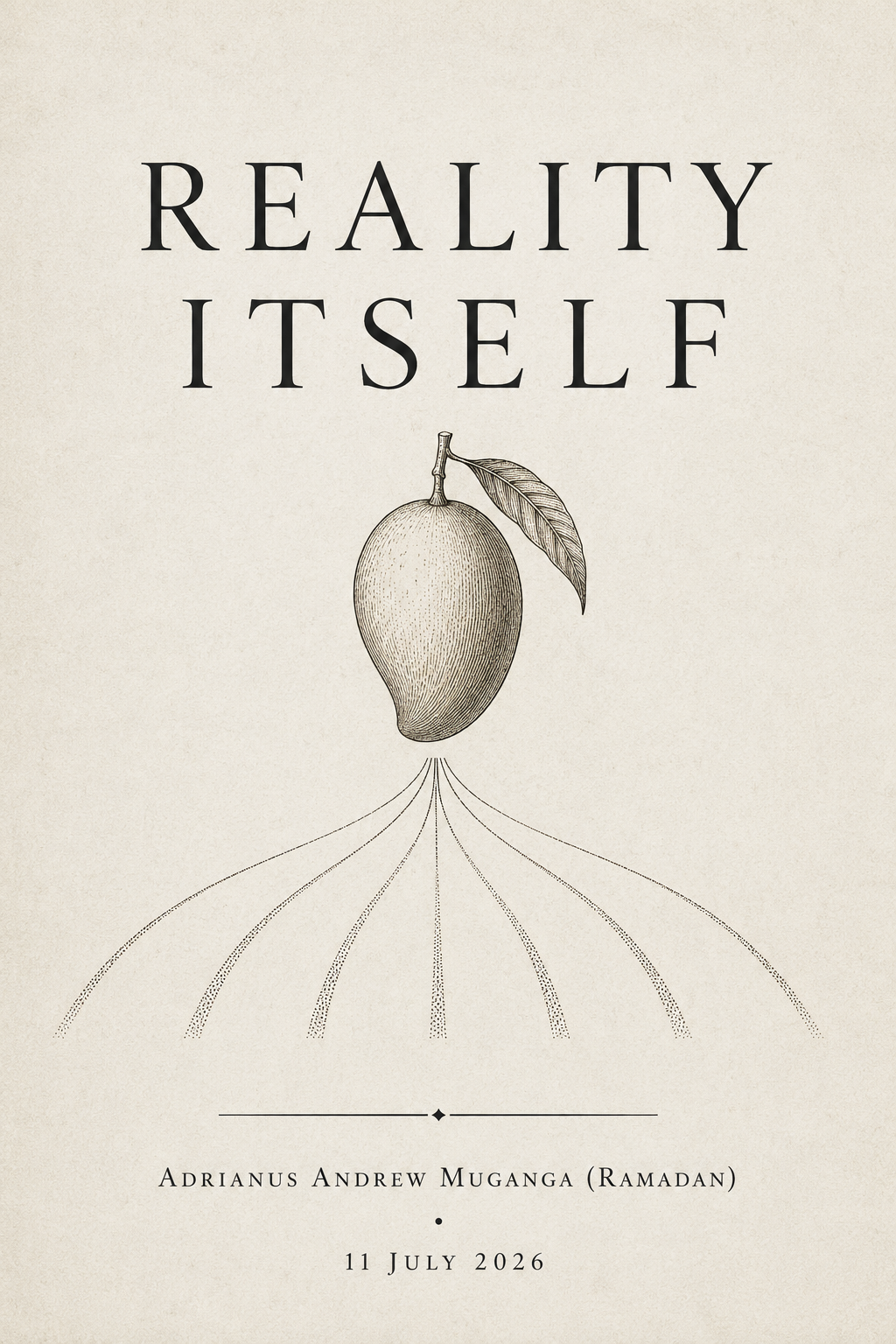
Reality Itself: An Interdisciplinary Reflection on the Unity of Reality and the Convergence of Human Inquiry. Reality Itself is a philosophical and interdisciplinary work that examines one of the most fundamental questions of human existence: If reality is one, why does human knowledge appear divided into so many separate disciplines? The book argues that while humanity has developed numerous fields of study—such as science, philosophy, law, governance, ecology, history, and spirituality—the object that all these disciplines seek to understand remains the same: reality itself.
The central thesis of the work is simple yet profound: Reality is one; human knowledge is many. Throughout history, human beings have organized knowledge into specialized disciplines to make complex questions easier to investigate. This specialization has been one of civilization’s greatest achievements because it has enabled deeper understanding and remarkable progress in science, technology, governance, and culture. However, the author argues that the division of knowledge should not be mistaken for a division of reality. The boundaries between disciplines are created by human methods of inquiry, not by reality itself.
The book begins by examining the nature of specialization. Physics studies matter and energy, biology studies living organisms, ecology studies relationships among living systems, governance studies social organization, philosophy studies reason and existence, and spirituality explores meaning and transcendence. Each discipline employs different methods and languages, yet all investigate aspects of the same world. According to the author, the diversity lies in the paths of inquiry, while the unity lies in the reality toward which those paths converge.
A major theme of the book is the convergence of independent inquiry. The author observes that disciplines developed independently often discover similar principles. Scientists, philosophers, ecologists, historians, constitutional thinkers, and spiritual scholars frequently encounter recurring concepts such as order, coherence, adaptation, continuity, balance, relationship, and interdependence. Although these ideas are expressed differently in each field, they often describe comparable patterns. This recurring convergence suggests that reality possesses an underlying order that exists independently of the observer.
The book emphasizes that this convergence does not mean all disciplines are identical or that one field can replace another. Instead, each discipline contributes a unique perspective. Their agreement on certain structural principles is significant because it points toward a common foundation underlying the diversity of knowledge. The author argues that independent paths of inquiry do not create reality; they reveal it. The more disciplines advance, the more they uncover aspects of the same interconnected whole.
Another important section of the work describes the author’s own interdisciplinary journey. The investigation did not begin as an attempt to create a grand philosophical theory. Instead, it emerged through practical studies in agriculture. Questions arising from agricultural research led naturally to environmental concerns. Environmental issues raised questions about governance and institutions. Governance led to constitutional design, which expanded into systems thinking, civilization studies, philosophy, and spirituality. Each field revealed questions that could not be fully answered within its own boundaries. As the inquiry expanded, recurring principles became increasingly visible across disciplines.
This process led to a key realization: what initially appeared to be separate subjects were actually different dimensions of a larger reality. The transition from one field to another was not a movement between unrelated topics but a gradual discovery of the interconnectedness of existence. The author describes this as the “progressive enlargement of inquiry,” in which each stage of investigation requires a broader framework capable of explaining relationships that had previously remained hidden.
The book presents an image of reality as an integrated whole rather than a collection of isolated objects or systems. Reality is portrayed as fundamentally relational, organized, continuous, adaptive, coherent, and dynamic. Diversity exists, but diversity operates within a larger unity. Specialization remains necessary because no single discipline can fully explain reality on its own. However, fragmentation becomes problematic when disciplinary boundaries are treated as barriers rather than useful tools for investigation.
According to the author, reality cannot be reduced to any single dimension. It cannot be explained solely through matter, energy, information, consciousness, society, nature, or spirituality. Each of these perspectives reveals genuine aspects of reality, but none exhausts its full meaning. A complete understanding requires the recognition that different disciplines illuminate different dimensions of the same interconnected whole.
The practical implications of this perspective are explored throughout the book. Scientific progress can benefit from philosophical reflection. Governance can be strengthened by ecological understanding. Constitutional systems become more resilient when informed by systems thinking. Environmental sustainability depends upon social and institutional organization. Spiritual inquiry contributes to ethical responsibility and meaning. Human knowledge advances most effectively when disciplines cooperate while maintaining their distinct identities.
The author argues that future progress depends not on creating a single universal discipline or theory, but on fostering meaningful dialogue among existing fields of knowledge. Integration should not eliminate diversity; rather, it should recognize the unity that diversity reveals. This approach encourages intellectual humility because no discipline, institution, or generation can claim complete knowledge of reality. Every discovery expands understanding while simultaneously revealing new questions.
A recurring message throughout the book is that reality consistently exceeds any individual perspective. Therefore, inquiry should be guided by mutual respect, openness, and cooperation across disciplines. The goal is not certainty or intellectual domination but a deeper coherence in human understanding. The author views this orientation as essential for addressing the increasingly complex challenges facing humanity in areas such as science, governance, education, environmental stewardship, and social development.
In its concluding reflections, Reality Itself presents a vision of knowledge as a continuing journey rather than a completed achievement. Human civilization advances by preserving the richness of its intellectual diversity while recognizing the deeper unity that connects all genuine inquiry. The work ultimately suggests that the future of knowledge lies not in further fragmentation but in a growing awareness of the interconnected reality that all disciplines seek to understand.
The book closes with its most memorable insight: Reality has never been divided; human understanding has been. The enduring task of civilization is to rediscover their unity. This statement captures the essence of the work and serves as both its conclusion and its invitation to future generations of scholars, practitioners, and thinkers.
#Reality
#Interdisciplinary Research
#Unity Of Knowledge
#Human Inquiry
#Systems Thinking
#Philosophy Of Reality
#Knowledge Integration
#Scientific Inquiry
#Interconnectedness
#Complexity Theory
#Epistemology
#Ontology
#Governance Studies
#Environmental Sustainability
#Constitutional Architecture
#Spiritual Inquiry
#Organizational Systems
#Intellectual Convergence
#Coherence Theory
#Civilization Studies.



![The Nu African Calendar [Volume One] book by Dia Mari-Jata](https://xania.goelway.com/assets/books/frontcoverimgs/NU AFRICAN BOOK COVER VOL 1 FRONT_ebookfrontcover.JPG)