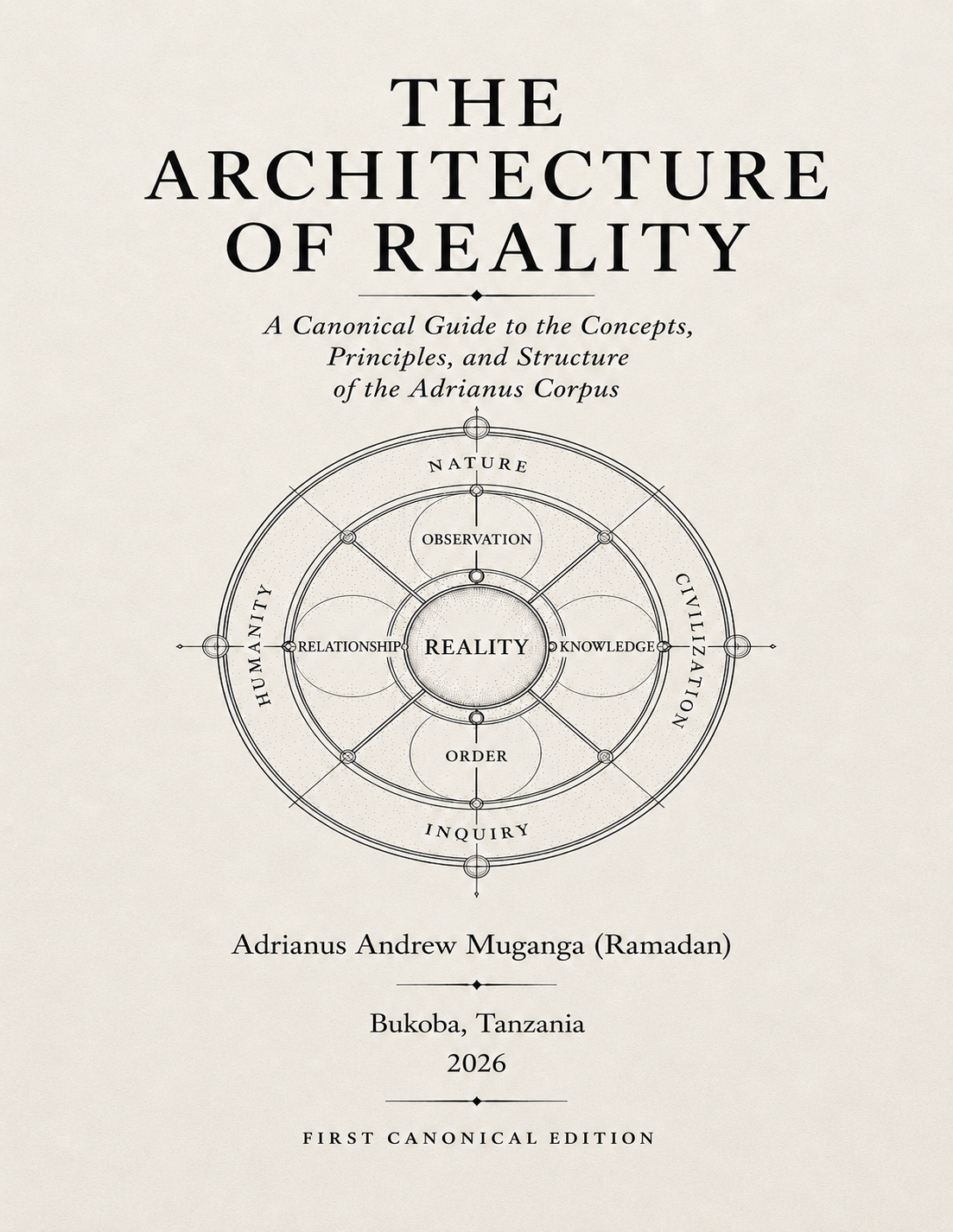
The Architecture of Reality: A Canonical Guide to the Concepts, Principles, and Structure of the Adrianus Corpus is the official scholarly reference work of the Adrianus Corpus. Unlike a conventional philosophical book that seeks to advance a single argument or introduce a new theory, this volume serves as the definitive guide to understanding the intellectual architecture of an extensive body of interdisciplinary scholarship. It has been prepared to organize, define, and document the foundational propositions, canonical concepts, methods of inquiry, figures, standardized terminology, and documentary relationships that have emerged throughout the development of the Adrianus Corpus.
The work is founded on the principle that as a body of scholarship grows across multiple disciplines and publications, its internal organization becomes as important as its individual contributions. Rather than treating books and articles as isolated works, The Architecture of Reality demonstrates how they are connected through recurring concepts, shared principles, and a coherent framework of inquiry. The result is a structured reference that enables readers to navigate the corpus systematically while preserving the independence and depth of each primary publication.
At the heart of the book is the proposition that reality exists independently of the systems human beings create to understand it. Knowledge develops through observation, inquiry, pattern recognition, conceptual formation, and interdisciplinary integration. Disciplines such as philosophy, science, governance, agriculture, ecology, education, constitutional design, artificial intelligence, and civilization studies are presented not as isolated fields but as complementary perspectives examining the same underlying reality. This understanding provides the intellectual foundation upon which the entire reference work is constructed.
The opening chapters establish the purpose of the reference work, explain the evolution of the inquiry that gave rise to the Adrianus Corpus, describe the method through which its concepts have been identified and organized, and present the architecture that guides the remainder of the volume. These chapters clarify that the book is organizational rather than argumentative. It documents an existing framework instead of introducing an entirely new philosophical system. Readers are therefore provided with the context necessary to understand how the corpus developed and how its individual publications contribute to a larger intellectual whole.
The volume then presents the foundational propositions that define the philosophical basis of the corpus. These propositions explore the relationship between reality, observation, knowledge, and human understanding. They emphasize that reality precedes every explanatory system, observation precedes disciplinary specialization, and knowledge follows reality rather than creating it. Together, these principles establish a consistent framework through which the subsequent concepts and applications can be interpreted.
Building upon these foundations, the book introduces a comprehensive collection of canonical concepts that form the core vocabulary of the Adrianus Corpus. Each concept is presented according to a standardized editorial structure consisting of a canonical definition, explanatory discussion, illustrative examples, related concepts, and documentary references. This consistent organization enables readers to understand each concept independently while recognizing its relationship to the broader intellectual framework. Concepts such as order, interdependence, integration, civilization, humanity, scale, inquiry, and the architecture of reality collectively describe the recurring patterns observed across natural, social, and institutional systems.
Recognizing that many relationships are best understood visually, the reference also includes a collection of canonical figures that illustrate the structural organization of the framework. These figures are not decorative additions but essential explanatory tools. They demonstrate recurring relationships among concepts, disciplines, systems, and scales, helping readers understand how apparently diverse fields share common organizational principles. Visual representations complement the textual discussions by making complex relationships more accessible and easier to compare across different contexts.
To ensure consistency throughout the corpus, the book establishes a canonical vocabulary that standardizes terminology across all publications. Definitions are carefully documented to eliminate ambiguity and provide a reliable foundation for research, teaching, citation, translation, and future scholarship. Cross references connect related concepts, propositions, figures, and publications, enabling readers to move confidently throughout the corpus while maintaining a clear understanding of its conceptual organization.
Beyond defining concepts, The Architecture of Reality documents the historical development of the Adrianus Corpus itself. It traces the evolution of major ideas, records publication chronology, identifies recurring research questions, and maps the relationships among books, articles, themes, and figures. This documentary foundation enables readers to appreciate not only individual publications but also the progression of inquiry that produced the integrated framework documented throughout the volume.
The book further demonstrates how the principles documented within the corpus may inform diverse fields of inquiry. Applications extend to education, governance, constitutional design, ecology, agriculture, philosophy, economics, ethics, technology, artificial intelligence, and future studies. These applications are illustrative rather than prescriptive. Their purpose is to show how a unified understanding of reality and knowledge may contribute to interdisciplinary reflection while respecting the established methods and specialized expertise of individual disciplines.
A distinguishing feature of the work is its commitment to scholarly documentation. Extensive bibliographic references, publication histories, citation guidance, concept genealogies, appendices, indexes, and documentary records provide readers with the tools necessary for systematic research and verification. The volume therefore functions not only as an intellectual guide but also as an archival resource that preserves the long-term organization of the Adrianus Corpus for future generations of scholars.
Designed for researchers, educators, students, librarians, policymakers, and intellectually curious readers, The Architecture of Reality serves multiple purposes simultaneously. It introduces newcomers to the conceptual framework of the Adrianus Corpus, supports educators in teaching its ideas, assists researchers in tracing the evolution of concepts across publications, and provides librarians and archivists with a standardized reference for documentation and classification. Throughout the work, emphasis is placed on clarity, consistency, precision, and continuity.
Ultimately, The Architecture of Reality argues that understanding a mature body of scholarship requires more than reading individual publications. It requires an organized framework capable of revealing the relationships that unite them into a coherent whole. By documenting those relationships through carefully defined concepts, foundational propositions, visual frameworks, standardized terminology, and comprehensive documentary references, this volume preserves the intellectual architecture of the Adrianus Corpus while providing a permanent guide for continued study and interdisciplinary inquiry. It stands as the definitive reference work for the corpus and an enduring contribution to the organization and communication of scholarly knowledge.
#Architecture Of Reality
#Adrianus Corpus
#Canonical Reference
#Philosophy Of Reality
#Interdisciplinary Philosophy
#Theory Of Reality
#Ontology
#Epistemology
#Philosophy Reference
#Scholarly Reference
#Intellectual Framework
#Conceptual Framework
#Systems Thinking
#Interdisciplinary Research
#Philosophy Book
#Knowledge Organization
#Philosophy And Science
#Reality And Knowledge
#Human Civilization
#Civilization Studies
#Governance Theory
#Constitutional Design
#Philosophy Of Knowledge
#Observation And Reality
#Conceptual Analysis
#Academic Philosophy
#Research Methodology
#Philosophy Of Science
#Systems Philosophy
#Intellectual History
#Philosophical Concepts
#Canonical Concepts
#Interdisciplinary Studies
#Reference Handbook
#Academic Reference
#Educational Resource
#Organizational Theory
#Complexity Thinking
#Integrated Knowledge
#Philosophy Scholars
#Research Reference
#Conceptual Vocabulary
#Long Term Civilization
#Reality Studies
#Human Development
#Knowledge Systems
#Philosophical Inquiry
#Academic Research
#Contemporary Philosophy
#Foundational Philosophy