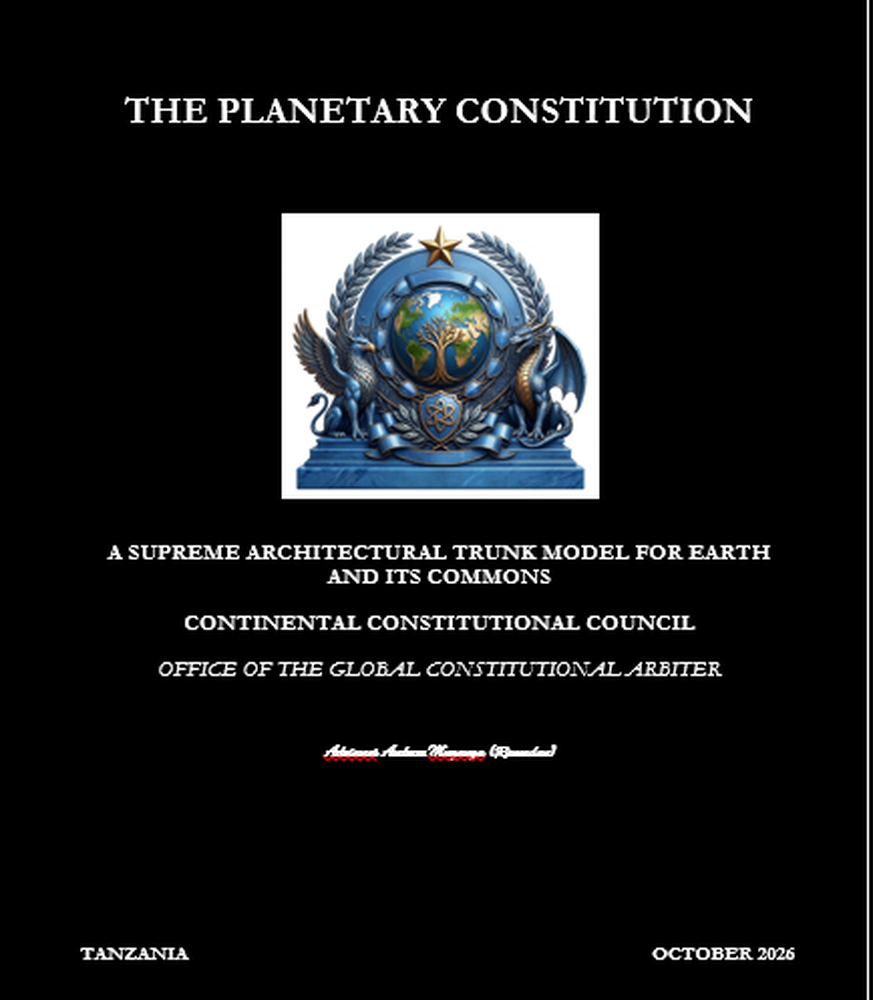
The Planetary Constitution: A Supreme Architectural Trunk Model for Earth and Its Commons presents an ambitious constitutional design for rethinking the organization of human civilization in an interconnected world. Comprising 14 Parts, 48 Chapters, and 240 Articles, the work proposes an integrated framework for planetary governance founded on constitutional supremacy, natural law, human dignity, institutional accountability, scientific responsibility, and the protection of Earth's shared ecological systems. Its central vision is to explore how humanity might develop a coherent system of global cooperation capable of addressing challenges that transcend national borders while preserving meaningful continental, regional, and local autonomy.
The work begins with a fundamental constitutional question: how can humanity coordinate its common responsibilities without allowing political power, economic influence, technological capacity, or individual leadership to become greater than the institutions designed to regulate them? In response, the author advances a structural approach to governance in which the legitimacy of public authority depends on constitutional limits, transparent institutional functions, enforceable rights, and an enduring obligation to serve the common good. Rather than presenting planetary governance solely as a diplomatic arrangement among existing states, the proposal examines it as a comprehensive constitutional architecture connecting political institutions, public finance, ecological stewardship, scientific knowledge, and social protection.
At the foundation of this architecture is the principle that human civilization operates within the physical realities and ecological limits of the Earth. The manuscript draws on natural systems and biological organization as conceptual models for institutional coordination, balance, feedback, and resilience. Its proposed governance philosophy emphasizes the interdependence of human communities and the biosphere, arguing that durable political and economic arrangements must account for the consequences of human activity across geographical boundaries and generations. Within this framework, the Earth’s atmosphere, oceans, ecosystems, natural resources, and other shared systems are treated as matters of collective responsibility requiring credible oversight and long-term protection.
A defining feature of the proposal is its organization of planetary governance through six Continental Unions coordinated within a supreme constitutional structure. This model seeks to reconcile continental representation with shared planetary responsibilities, distributing authority across interconnected levels rather than concentrating every function in a single administrative center. The constitutional design places particular emphasis on subsidiarity, functional specialization, institutional cooperation, and the preservation of local and cultural autonomy within established constitutional boundaries. Its objective is to establish a system in which decisions can be addressed at the appropriate level while matters affecting humanity collectively receive coordinated consideration.
The proposed separation of powers forms another central pillar of the work. The model establishes a tri-chamber legislative system, a rotational executive council, and an independent judicial structure. These institutions are designed to distribute representation, constrain unilateral authority, and subject public decisions to constitutional review. The manuscript also proposes safeguards intended to prevent corruption, institutional capture, executive overreach, and the concentration of authority around individual leaders. Its approach places the durability of institutions above the ambitions of officeholders, seeking to make accountability a structural requirement rather than a voluntary commitment.
The judicial and constitutional enforcement provisions further explore how rights and institutional limits might remain effective during periods of political instability or planetary emergency. The proposal emphasizes judicial independence, access to legal remedies, legislative oversight, and restrictions on emergency powers. It argues that crises should not become opportunities to eliminate constitutional protections or permanently expand executive authority. These provisions reflect a broader commitment to the principle that public power must remain legally bounded, including when institutions face extraordinary pressures.
Economic and financial governance receive substantial attention. The manuscript proposes a Planetary Treasury connected to the management of shared-resource revenues, public institutional funding, financial accountability, and the allocation of resources across the six Continental Unions. It examines mechanisms intended to reduce political interference in public financing, discourage speculative exploitation of common resources, and direct a portion of planetary economic activity toward collective responsibilities. These proposals seek to connect economic administration with ecological realities and constitutional obligations, making financial architecture an integral component of governance rather than a separate technical concern.
Environmental protection is developed through proposed planetary monitoring systems, ecological feedback mechanisms, atmospheric safeguards, and controls on activities that could threaten shared environmental stability. The work envisions the use of scientific observation, transparent data systems, and institutional response mechanisms to identify ecological risks and support timely intervention. It also addresses the governance of the atmosphere, orbital space, electromagnetic resources, and other domains whose use can produce consequences far beyond the jurisdiction of any single community. The underlying principle is that technological and economic capabilities affecting planetary systems should be subject to rigorous public accountability and collective safeguards.
The constitutional framework also extends into science, public health, and digital governance. It proposes coordinated biological monitoring and early-warning mechanisms for emerging health threats, alongside cooperation across continental boundaries. In the technological sphere, the manuscript considers artificial intelligence, digital infrastructure, information rights, privacy, and the responsibilities associated with increasingly automated systems. These provisions reflect the author's view that constitutional thinking must evolve alongside scientific and technological development, ensuring that innovation is examined in relation to human dignity, public safety, individual freedoms, and the long-term interests of society.
Human welfare remains an important dimension of the proposed architecture. The work addresses labor protections, employment due process, workplace safety, access to labor justice, family welfare, cultural and indigenous heritage, and the interests of future generations. It proposes institutional mechanisms intended to protect vulnerable individuals, improve access to remedies, and connect social rights with enforceable administrative responsibilities. By including these subjects within a single constitutional framework, the manuscript presents social protection not merely as a collection of separate policy objectives, but as part of the wider responsibilities of public institutions.
Ultimately, The Planetary Constitution is an invitation to examine the constitutional foundations of humanity’s shared future. Its significance lies in the scale of its institutional ambition and its attempt to integrate political authority, economic systems, ecological stewardship, scientific oversight, technological governance, and human welfare into one proposed design. The framework raises substantial questions about democratic legitimacy, continental representation, enforceability, institutional feasibility, individual liberty, and the transition from existing national and international arrangements. These questions make careful scholarly scrutiny, public debate, and critical evaluation essential to its consideration.
This publication is an independent constitutional proposal, not an adopted constitution, binding international treaty, or official policy of any government or international organization. It is offered as a framework for research, discussion, criticism, and further development. Its overarching purpose is to contribute to the search for institutional arrangements through which humanity may better coordinate its common responsibilities, protect the Earth’s shared systems, uphold human dignity, and consider the needs of generations yet to come.
#Planetary Governance
#Constitutional Design
#Constitutional Law
#Global Governance
#International Relations