The Same Order: An Interdisciplinary Reflection on the Organization of Reality Across Scales of Existence. The Same Order is an interdisciplinary philosophical work that investigates whether a single organizational principle operates throughout reality, from the smallest biological systems to the largest structures of civilization and human knowledge. Building upon the author's broader body of research, the book argues that reality possesses an objective order that exists independently of human observation and that human knowledge progresses through the gradual discovery of this preexisting order. The central claim of the work is that the same pattern of organization repeatedly appears across different scales of existence: distinct parts maintain their own identities while simultaneously participating in larger integrated wholes.
The book begins with a declaration that reality existed long before humanity developed language, science, philosophy, religion, or institutions. The movement of planets, the growth of forests, the germination of seeds, and the circulation of blood all occurred before human beings developed methods to study them. According to the author, this distinction is fundamental because reality is primary while human knowledge is secondary. Human beings do not create reality; they observe, interpret, and progressively understand it. Throughout history, scholars, philosophers, scientists, spiritual leaders, farmers, and innovators have contributed to human knowledge by discovering patterns and principles that already existed rather than inventing the order itself.
The author argues that specialization emerged because reality is complex. As knowledge expanded, different disciplines developed to examine specific dimensions of existence. Biology studied living organisms, physics explored matter and energy, ecology investigated relationships among living systems, economics examined production and exchange, law organized social order, and philosophy reflected upon meaning and existence. Each discipline developed its own methods and language. However, the division of knowledge should not be mistaken for a division of reality. The boundaries between disciplines exist for practical reasons of investigation, while reality itself remains integrated.
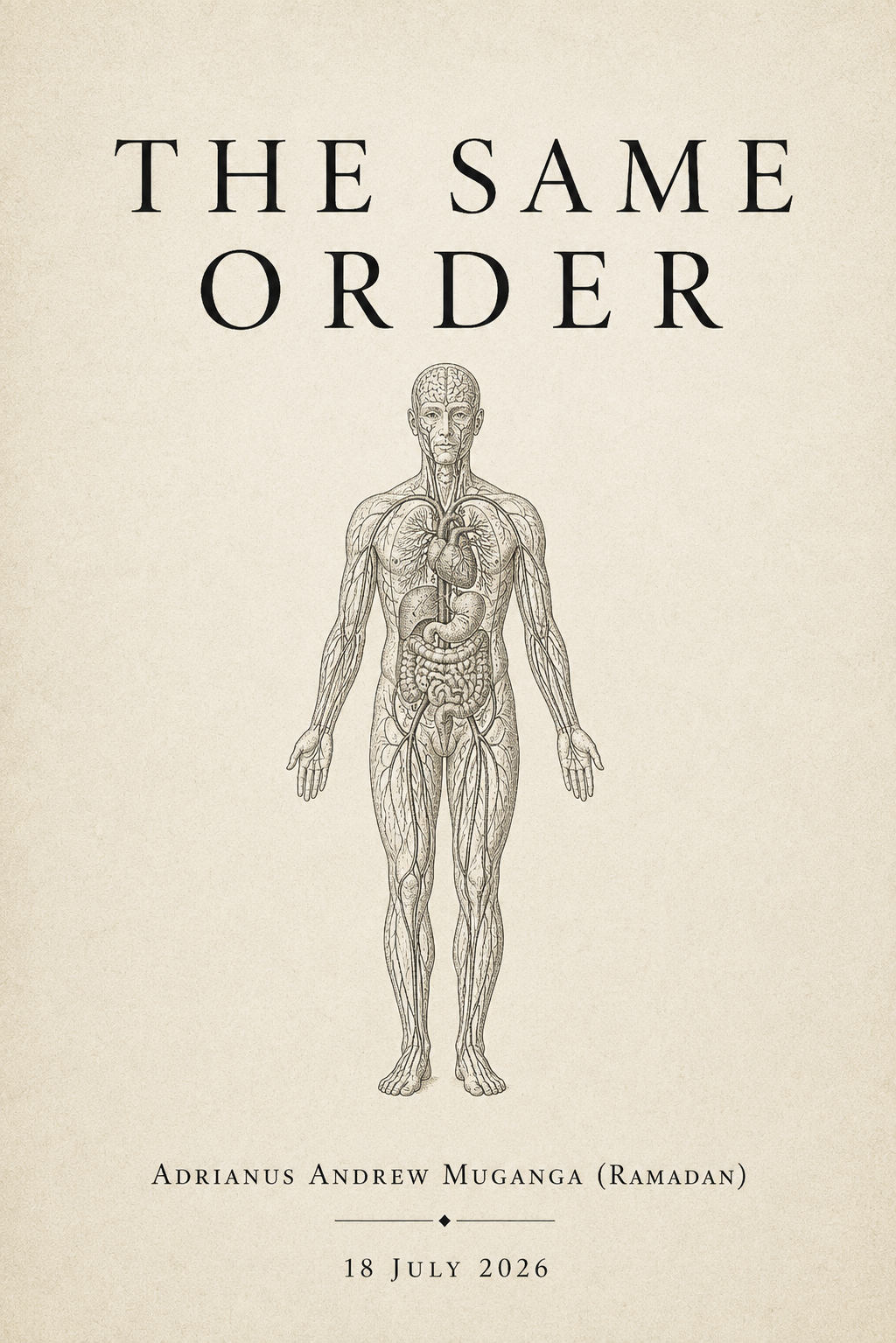
The first major observation examines the human body. The body appears as one living organism, yet it is composed of many specialized systems. The nervous system coordinates communication, the circulatory system transports nutrients and oxygen, the respiratory system exchanges gases, the digestive system processes food, the immune system provides protection, and the skeletal and muscular systems support movement and structure. Each system performs unique functions and cannot replace the others. Yet none can survive independently. Every system depends upon the coordinated activity of the others. The body therefore demonstrates a fundamental principle: unity does not arise from sameness but from the organized relationship of differentiated parts.
The significance of this observation extends beyond biology. Human inquiry has produced specialized disciplines such as cardiology, neurology, pulmonology, endocrinology, and immunology to study different systems of the body. These disciplines investigate distinct aspects of one organism rather than separate bodies. The organization of knowledge reflects the requirements of inquiry, not fragmentation within reality itself. The author concludes that diversity and unity are not opposing conditions but complementary characteristics of organized existence.
The second observation expands beyond the body to the environment. Although the body appears to be separated from the world by the skin, its existence depends entirely upon larger ecological systems. Every breath depends upon the atmosphere. Every meal depends upon soil, water, sunlight, plants, and ecological processes. Every cell depends upon countless exchanges with the environment. The body survives not through isolation but through continuous participation in larger systems.
The author demonstrates that forests depend upon rainfall, microorganisms, soils, and climate. Rivers depend upon geological processes, vegetation, and precipitation. Agricultural systems depend upon biodiversity, pollinators, and ecological stability. Oceans regulate climate and support complex networks of life. Each system maintains its own identity while depending upon relationships with other systems. The same organizational pattern observed within the body reappears within ecosystems. The scale changes, but the principle remains consistent.
The third observation turns to the development of human knowledge itself. Human understanding emerged in response to reality rather than preceding it. Early human beings observed natural phenomena, accumulated experience, and gradually organized their observations into structured knowledge. Over time, disciplines developed to study particular aspects of reality in greater depth. Universities established faculties, departments, research institutes, and professional communities dedicated to specialized inquiry.
While specialization enabled remarkable advances, it also encouraged the mistaken impression that reality itself is divided into separate domains corresponding to academic disciplines. The author argues that this is an illusion created by the organization of knowledge. Physics, biology, psychology, law, economics, engineering, philosophy, and history all investigate different dimensions of one reality. The boundaries separating disciplines exist within institutions, not within reality itself.
The work highlights historical figures such as Aristotle, Newton, Darwin, Einstein, Jung, physicians, engineers, farmers, and religious thinkers. Although these individuals worked in different contexts and used different methods, they all sought to understand aspects of the same larger order. Their discoveries enriched human understanding because reality disclosed its organization through their inquiries. The history of knowledge therefore reinforces the pattern observed in biology and ecology: specialization serves understanding, but reality remains integrated.
The fourth observation synthesizes the previous arguments and introduces the book’s central conclusion. Across multiple scales, the same organizational order repeatedly appears. Cells form tissues. Tissues form organs. Organs form organisms. Organisms participate in ecosystems. Human beings create families, communities, institutions, nations, and civilizations. Civilization develops systems of knowledge to understand reality. At every level, distinguishable units retain their identities while simultaneously participating within larger organized wholes.
This recurring pattern reveals that diversity is not opposed to unity. Cells differ from one another. Species occupy different ecological roles. Institutions perform different social functions. Disciplines employ different methods. Cultures possess distinct traditions. Diversity is a natural characteristic of reality. Problems arise only when distinction is mistaken for independence. The author argues that every organized system depends upon relationships among differentiated components. Diversity and integration therefore work together rather than against each other.
The implications of this conclusion extend beyond theory. The author argues that scientific progress benefits when relationships among disciplines are recognized. Environmental sustainability requires understanding the interconnectedness of ecological systems and human civilization. Educational institutions should encourage both specialization and interdisciplinary understanding. Governance becomes more effective when institutions cooperate rather than function in isolation. Knowledge grows through specialization, but wisdom grows through integration.
The final section applies these insights to humanity and civilization. Education should cultivate not only expertise but also the ability to recognize relationships across fields of knowledge. Institutions such as science, law, economics, governance, ecology, and philosophy each possess unique responsibilities, yet all contribute to the functioning of civilization as a larger whole. Future generations inherit a reality they did not create, and their responsibility is not to redefine reality according to temporary preferences but to understand its organization more completely.
The book concludes by asserting that humanity’s greatest challenge is not diversity itself but the failure to recognize the relationships that transform diversity into an integrated whole. Across the human body, ecological systems, human knowledge, and civilization, the same organizational order continually appears. Reality has always possessed this order. Human knowledge advances by discovering it, and civilization flourishes when it aligns itself with it. The enduring message of The Same Order is that reality is organized through relationships that preserve both distinction and integration. The same order that governs life, knowledge, and civilization has always existed, and humanity’s task is to understand and live in harmony with it.
#The Same Order
#Organization Of Reality
#Interdisciplinary Research
#Systems Theory
#Integrated Reality
#Complexity Science
#Human Knowledge
#Ecological Systems
#Biological Organization
#Interdependence
#Organizational Principles
#Reality Studies
#Philosophy Of Science
#Knowledge Integration
#Civilizational Development
#Systems Thinking
#Ecological Interconnectedness
#Social Organization
#Unity And Diversity
#Holistic Inquiry.









![The Nu African Calendar [Volume One] book by Dia Mari-Jata](https://xania.goelway.com/assets/books/frontcoverimgs/NU AFRICAN BOOK COVER VOL 1 FRONT_ebookfrontcover.JPG)