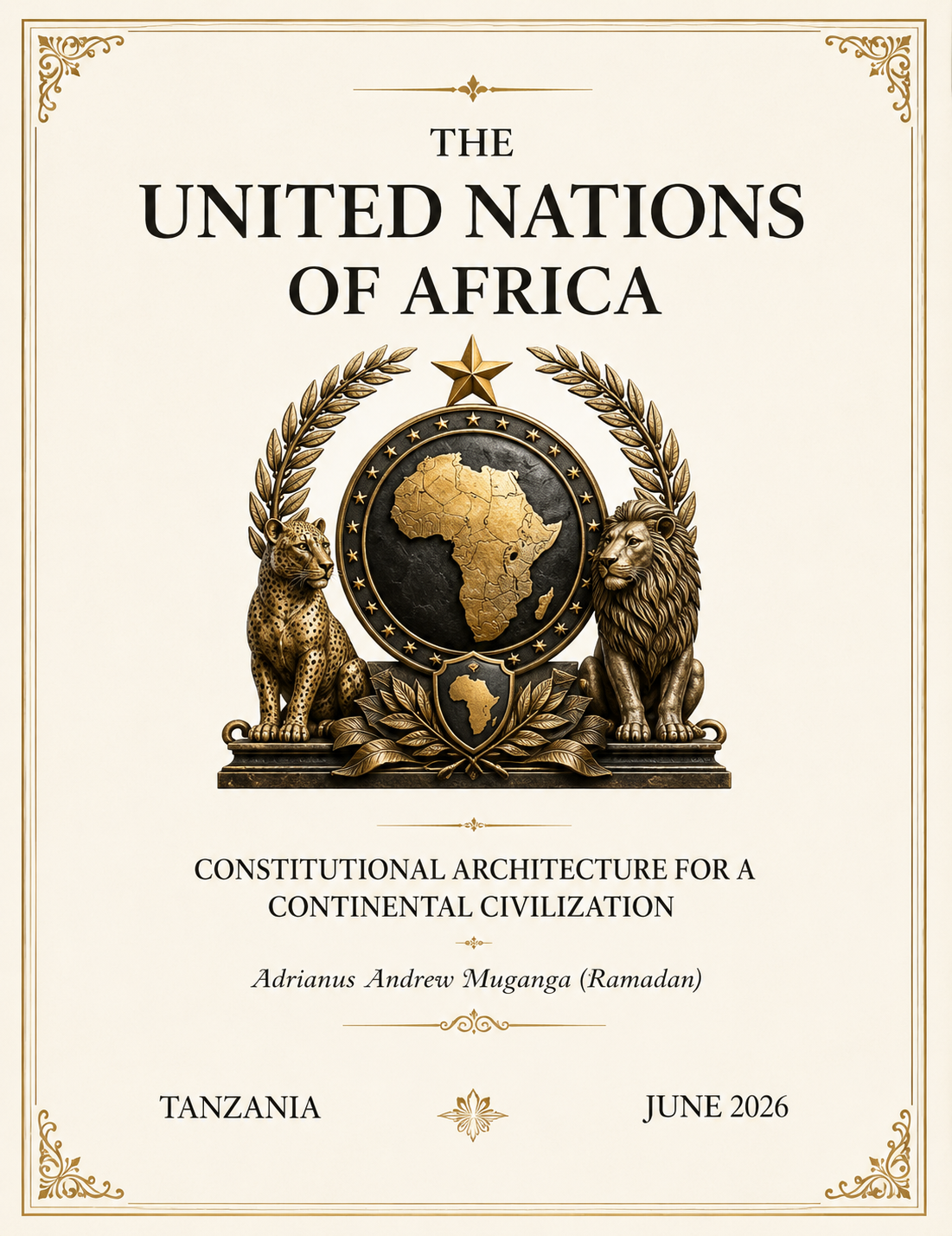
The United Nations of Africa: Constitutional Architecture for a Continental Civilization is an ambitious and comprehensive constitutional work that explores how a future continental union of African nations might be organized through democratic governance, constitutional law, accountable institutions, and long-term strategic planning. Conceived as an independent constitutional project, the work presents a complete framework for a hypothetical United Nations of Africa designed to promote peace, stability, prosperity, human development, scientific advancement, environmental stewardship, and the long-term advancement of African civilization.
At its foundation, the Constitution is built upon the belief that Africa possesses both the diversity and the potential necessary to sustain a constitutional union capable of addressing challenges that increasingly transcend national borders. The work recognizes that the continent contains thousands of cultural communities, hundreds of languages, multiple legal traditions, diverse political experiences, and a rich historical heritage. Rather than viewing this diversity as an obstacle, the constitutional framework seeks to demonstrate how unity and diversity can coexist within a stable and effective constitutional order. The proposed Union is designed to preserve national identities, cultural traditions, local institutions, and democratic self-government while simultaneously creating continental systems capable of supporting cooperation, development, security, and shared prosperity.
The Constitution establishes an extensive institutional architecture intended to provide clear rules, responsibilities, and safeguards for governance across generations. It addresses foundational constitutional principles, citizenship, rights and responsibilities, legislative authority, executive administration, judicial independence, constitutional oversight, public accountability, and the rule of law. The framework is designed to ensure that all public authority remains subject to constitutional limitations and that no institution, office holder, or political actor stands above the Constitution itself. Throughout the document, particular emphasis is placed upon the principle that public authority exists to serve the people rather than dominate them.
Beyond traditional constitutional subjects, the work expands into areas often overlooked by conventional constitutional design. It examines how constitutional systems may support economic transformation, industrial development, financial stability, continental infrastructure, technological innovation, digital sovereignty, scientific research, public health, education, and environmental sustainability. The Constitution proposes institutions capable of encouraging long-term investment, strengthening productivity, promoting knowledge creation, and improving the welfare of citizens across the continent. It seeks to establish governance systems that are not only politically legitimate but also capable of delivering measurable improvements in quality of life.
A central theme throughout the work is the relationship between governance and civilizational development. The Constitution argues that enduring prosperity and stability depend not only upon political institutions but also upon the cultivation of knowledge, scientific advancement, professional administration, ethical leadership, and responsible stewardship. As a result, the framework includes provisions intended to strengthen education systems, research institutions, innovation ecosystems, and long-term strategic planning capacities. The goal is to create constitutional conditions that enable future generations to inherit stronger institutions, greater opportunities, and a more prosperous continent than previous generations possessed.
The work also devotes significant attention to peace, security, and constitutional stability. It recognizes peace as a foundational constitutional principle and proposes mechanisms designed to prevent conflict, encourage mediation, strengthen regional cooperation, and preserve constitutional order. Security institutions are structured around the principle that they must remain powerful enough to defend the Union while remaining firmly subordinate to constitutional authority and democratic oversight. This approach reflects a broader commitment to balancing strength with accountability throughout the constitutional system.
Environmental stewardship and intergenerational responsibility form another major component of the constitutional framework. The Constitution recognizes that every generation inherits resources, institutions, knowledge, and responsibilities from those who came before and holds them in trust for those who will follow. It therefore incorporates principles of sustainability, conservation, responsible resource management, climate resilience, and long-term planning. Public institutions are encouraged to evaluate policies not only according to immediate benefits but also according to their long-term consequences for future generations.
One of the distinguishing features of the work is its emphasis on future-oriented governance. The Constitution acknowledges that technological transformation, artificial intelligence, digital systems, demographic growth, and emerging global challenges will reshape societies in profound ways during the coming century. Rather than treating these developments as secondary concerns, the framework seeks to establish constitutional mechanisms capable of adapting to changing circumstances while preserving democratic accountability, constitutional continuity, and public trust. In doing so, it attempts to bridge the gap between traditional constitutional design and the realities of an increasingly complex and interconnected world.
The Constitution is not presented as a political manifesto, revolutionary program, or official governmental proposal. Instead, it is offered as a scholarly exercise in constitutional design, institutional architecture, and long-term governance planning. Its purpose is to encourage discussion, analysis, research, and debate regarding the future possibilities of African integration and constitutional development. Readers are invited to evaluate the framework not as a prediction of future events but as a detailed exploration of how large-scale constitutional cooperation might be organized through lawful, democratic, and peaceful means.
Intended for constitutional scholars, policymakers, legal practitioners, political scientists, economists, educators, students, researchers, and citizens interested in governance and development, The United Nations of Africa: Constitutional Architecture for a Continental Civilization represents a significant contribution to discussions concerning statecraft, institutional innovation, continental integration, and the future of constitutional government. By combining constitutional principles with long-term strategic thinking, the work seeks to provide a vision of governance capable of supporting peace, prosperity, stability, knowledge, and human advancement across generations. At its heart lies a simple but enduring conviction: that strong institutions, constitutional accountability, responsible leadership, and cooperation among peoples and nations offer the most reliable foundation for a flourishing African future.
#African Constitution
#United Nations Of Africa
#Pan-Africanism
#African Union
#Constitutional Law
#Continental Governance
#Federalism
#Democratic Governance
#Political Science
#Public Administration
#Institutional Design
#African Integration
#Constitutional Architecture
#Rule Of Law
#Government Reform
#International Relations
#Economic Development
#Strategic Planning
#Future Governance
#Public Policy
#Civic Leadership
#Constitutional Democracy
#State Building
#African Development
#Regional Integration
#Governance Systems
#Political Institutions
#Civilizational Development
#Nation Building
#African Future