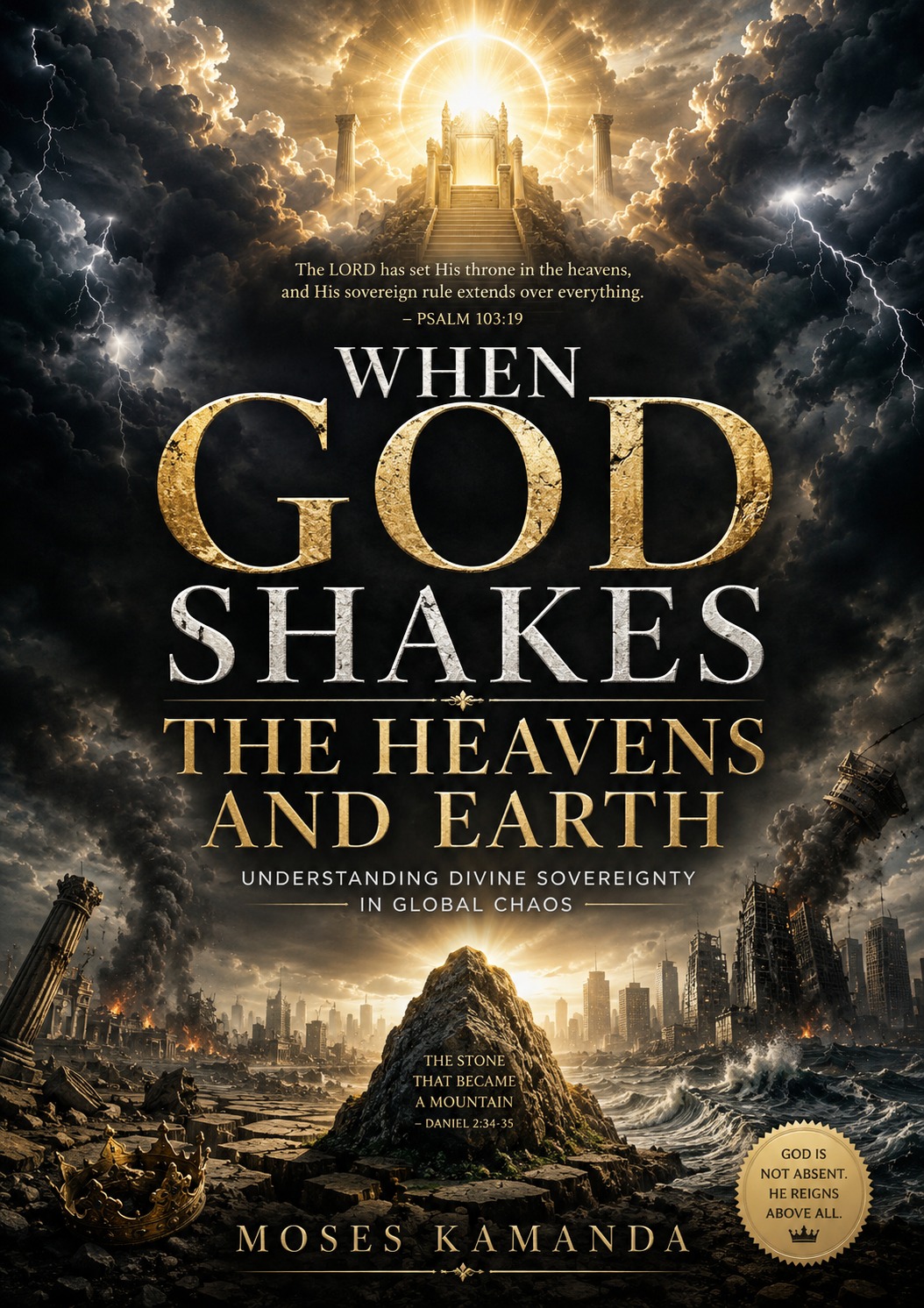
When God Shakes the Heavens And Earth
Subtitle: Understanding Divine Sovereignty In Global Chaos

Author: Moses Kamanda
This book seeks to encourage a believer that, despite the global chaos, economic shut down, and moral predicaments, God has not stopped being in control. It reassures readers that even when the world seems to spiral into uncertainty through financial collapse, ethical decay, or widespread fear, divine sovereignty remains unshaken. Furthermore, the book suggests that even within world governance structures, kingdoms, and political confusions, God is not absent. It argues that no election, policy shift, or international crisis escapes His awareness or authority. Instead of fostering despair, this perspective invites believers to recognize God’s quiet yet relentless work behind the scenes, using flawed systems and chaotic circumstances to accomplish His purposes. Whether through the rise and fall of leaders, economic turmoil, or moral ambiguity, the book insists that God’s plan unfolds without interruption. Ultimately, it calls believers to a posture of trust, prayer, and active hope, not withdrawal or panic.
Keywords for this book
You can only order 1 ebook at a time
Book summary
In an age marked by wars, economic ruin, and a pervasive loss of moral direction, many, even some who claim to be believers feel as though God has turned His gaze elsewhere. The image that often surfaces is one of a runaway train hurtling through a chaotic world, while the Creator looks on from a distance. This perception of divine detachment is understandable given the scale of suffering, visible across news headlines and personal tragedies alike. Yet this image does not line up with what Scripture actually teaches. As Psalm 103:19 (NASB) affirms, “The Lord has set His throne in the heavens, and His sovereign rule extends over everything.” The psalmist here declares not a distant monarch but a reigning King whose authority touches every corner of creation. This book argues that when the cosmos trembles and societal upheaval seem to intensify, those signs do not prove God’s absence or indifference. Rather, they signal a shift that the church must recognize and interpret so that believers can understand God’s activity across the various realms of existence. The prophet Amos asked, “If a calamity occurs in a city has not the Lord done it?” (Amos 3:6, NASB), 7 suggesting that even what appears as random destruction may fall within the scope of divine purpose. We find ourselves bewildered by a planet riddled with identity crises, rampant lawlessness, and theological confusion. The Once grand cathedrals—whether in the West or elsewhere—are now crumbling shells, their stones bearing silent witness to a faith that has in many places grown cold. Many churches have become sprawling, compromised institutions; their spiritual decay cannot be blamed merely on a lack of prayer or funding (some even enjoy financial abundance beyond their needs). The apostle Paul warned Timothy that “in the last days difficult times will come” (2 Timothy 3:1, NASB), describing a period marked by love-lessness, indiscipline, and a form of godliness that denies its power. The core question, then, becomes: What exactly is the problem? Why do church structures appear so fragmented and kaleidoscopic in the 21st century? The Scriptures offer no simple diagnosis but point consistently to a departure from wholehearted devotion. As the Lord charged Israel through the prophet Hosea, “My people are destroyed for lack of knowledge” (Hosea 4:6, NASB) a knowledge not merely informational but relational and obedient.
Book details
No other books by this author.