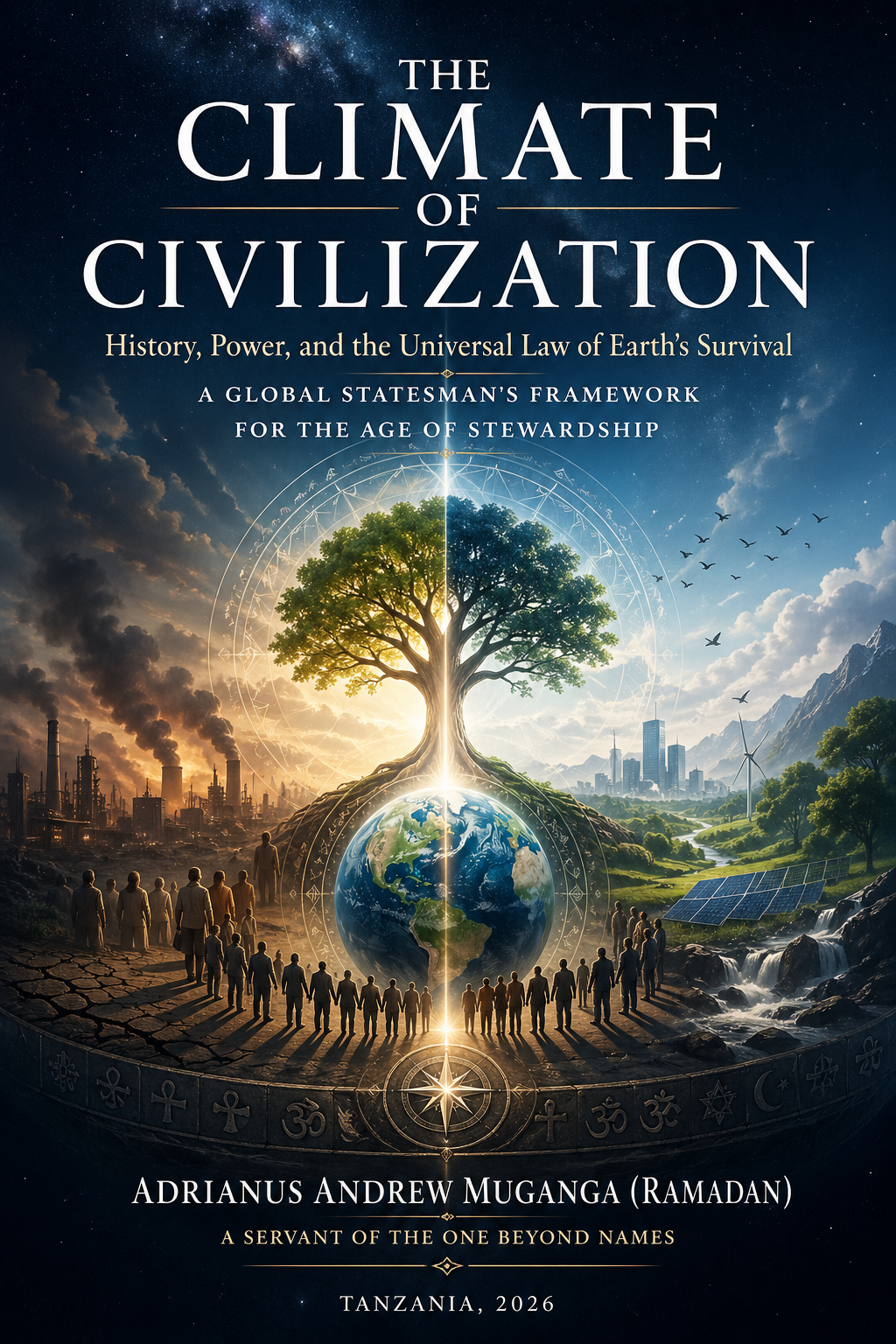
THE CLIMATE OF CIVILIZATION: History, Power, and the Universal Law of Earth's Survival
Subtitle: A Global Statesman's Framework For The Age Of Stewardship
Author: Adrianus Muganga
The Climate of Civilization: History, Power, and the Universal Law of Earth's Survival examines climate change as the defining civilizational challenge of the twenty-first century. Adrianus Andrew Muganga traces humanity's journey from its emergence in prehistoric Africa through the Holocene, the Industrial Revolution, and the rise of fossil-fuel civilization, showing how a species once shaped by climate has become powerful enough to reshape it. Combining climate science, economics, geopolitics, history, and systems thinking, the book demonstrates that climate change is not merely an environmental issue, but a test of whether human power can mature into planetary stewardship. It analyzes the causes of atmospheric warming, the inadequacy of current policies, the strategic importance of emerging economies, and the pathways toward decarbonization, resilience, and global cooperation. Rigorous, accessible, and forward-looking, this work offers a comprehensive framework for understanding the climate century. Humanity has acquired planetary power; the central question is whether it
Keywords for this book
You can only order 1 ebook at a time
Book summary
The Climate of Civilization: History, Power, and the Universal Law of Earth's Survival is a comprehensive examination of the greatest strategic challenge ever faced by humanity: whether an advanced industrial civilization can align its immense capabilities with the physical realities of the planet that sustains it. Climate change, in this framework, is not merely an environmental issue. It is the central civilizational question of the twenty-first century. It touches every major system upon which modern life depends energy, agriculture, economics, finance, infrastructure, public health, migration, national security, and the geopolitical balance of nations. The book begins by placing humanity within the deep history of Earth. For nearly 300,000 years, Homo sapiens lived entirely within climatic systems it could neither influence nor control. Ice ages advanced and retreated. Sea levels rose and fell. Rainfall patterns shifted. Human populations adapted, migrated, and survived. Climate set the boundaries, and civilization did not yet exist. Then, approximately 11,700 years ago, the Holocene began. This unusually stable climatic period provided the environmental conditions necessary for agriculture, permanent settlements, cities, writing, trade, and the eventual emergence of complex civilization. Stability, it turns out, was the hidden infrastructure of history. For ten millennia, human societies expanded while remaining relatively small compared to the planetary systems around them. Atmospheric carbon dioxide fluctuated within natural boundaries. Population growth was slow. Human influence was often locally significant, but globally limited. The relationship between civilization and nature remained largely one-directional: climate shaped humanity. That relationship changed decisively with the Industrial Revolution. The discovery and widespread use of coal, followed by oil and natural gas, unlocked vast stores of ancient solar energy. Fossil fuels allowed humanity to escape many of the biological limits that had constrained previous civilizations. Industrial output soared. Transportation networks expanded across continents and oceans. Agricultural productivity increased dramatically. Population surged from roughly one billion in 1800 to more than eight billion today. Economic growth accelerated at a pace unprecedented in human history. Yet these extraordinary achievements came with an unintended consequence. The same energy systems that transformed civilization also transferred massive quantities of carbon from geological storage into the atmosphere. Atmospheric carbon dioxide rose from approximately 280 parts per million before industrialization to more than 425 parts per million in the modern era. Global temperatures increased. Oceans absorbed vast quantities of excess heat. Glaciers and ice sheets began retreating. Sea levels rose. Ecosystems shifted. For the first time in Earth's history, a single species became capable of altering planetary systems at global scale. Humanity became a geological force. The book argues that climate change is the direct consequence of a deeper structural reality: human power has expanded faster than human governance. Industrial civilization mastered extraction, production, and expansion, but it did not fully account for the physical limits of the atmosphere, oceans, and biosphere. The climate crisis is therefore not simply a failure of technology. It is a failure of alignment. Civilizations endure when they operate within the laws of the systems that sustain them. They destabilize when they exceed those limits. A major strength of the book is its systems approach. Climate change cannot be understood through atmospheric science alone. Carbon emissions arise from energy systems. Energy systems are embedded within economies. Economies are governed by institutions. Institutions are shaped by history, incentives, power, and political structures. The atmosphere integrates all of it without favoritism. Physics counts molecules, not intentions. The book carefully examines the present condition of the planet. Atmospheric carbon concentrations continue rising. Global temperatures have already increased substantially above pre-industrial levels. Heatwaves intensify. Droughts expand. Floods become more destructive. Wildfire seasons lengthen. Sea levels rise with increasing momentum. Coral reefs bleach. Agricultural systems face mounting pressure. Climate change is no longer a future scenario. It is a present operating condition. The analysis then turns toward the future. Several pathways remain possible. Strong mitigation could stabilize warming near internationally agreed targets, preserving much of the climatic stability upon which modern civilization depends. Current policies, while improving, remain insufficient. High-emissions trajectories would produce profound disruptions to coastlines, water systems, food production, migration patterns, and geopolitical stability. The difference between these futures represents one of the largest policy choices in human history. Particular attention is given to the emerging multipolar world. Developing economies, especially across Africa and Asia, will drive much of the twenty-first century's population growth and energy demand. The central challenge is not whether development should occur. It must. The challenge is whether development can proceed along pathways compatible with planetary stability. This question will define global politics, finance, and industrial strategy for decades to come. Beyond diagnosis, The Climate of Civilization offers a practical agenda. It outlines the technologies, institutions, and policies necessary for the great transition. These include large-scale electrification, renewable energy deployment, advanced nuclear power, clean industrial processes, carbon management, regenerative agriculture, ecosystem restoration, resilient infrastructure, and universal access to modern energy. Climate stabilization will not be achieved through awareness alone. It will require investment, engineering, law, governance, and international cooperation at unprecedented scale. The book introduces the concept of planetary stewardship as the next stage of civilizational maturity. Humanity must evolve from a model based primarily on extraction and domination toward one based on renewal, balance, resilience, and long-term continuity. This is not a rejection of growth, innovation, or development. It is their necessary redesign. Underlying the entire work is a simple but profound principle: power and responsibility must grow together. Humanity has already acquired planetary power. The defining question is whether it can develop planetary wisdom. Future generations will not judge this era by its intentions, speeches, or conferences. They will judge it by atmospheric concentrations, preserved coastlines, restored ecosystems, and the quality of the institutions built to manage a changing world. Written in a rigorous, statesmanlike, and highly accessible style, the book speaks to policymakers, business leaders, investors, educators, students, and citizens alike. It rejects ideological simplification in favor of evidence, realism, and strategic clarity. It recognizes both the scale of the danger and the scale of human capability. Ultimately, The Climate of Civilization is about far more than climate alone. It is about the maturity of civilization itself. It asks whether humanity can align its intelligence, technology, and economic systems with the physical realities of Earth. It asks whether prosperity can be sustained within planetary boundaries. It asks whether a species powerful enough to alter the planet can become wise enough to preserve it. The answer remains unwritten. The twenty-first century will write it.
Book details






















_ebookfrontcover.png)