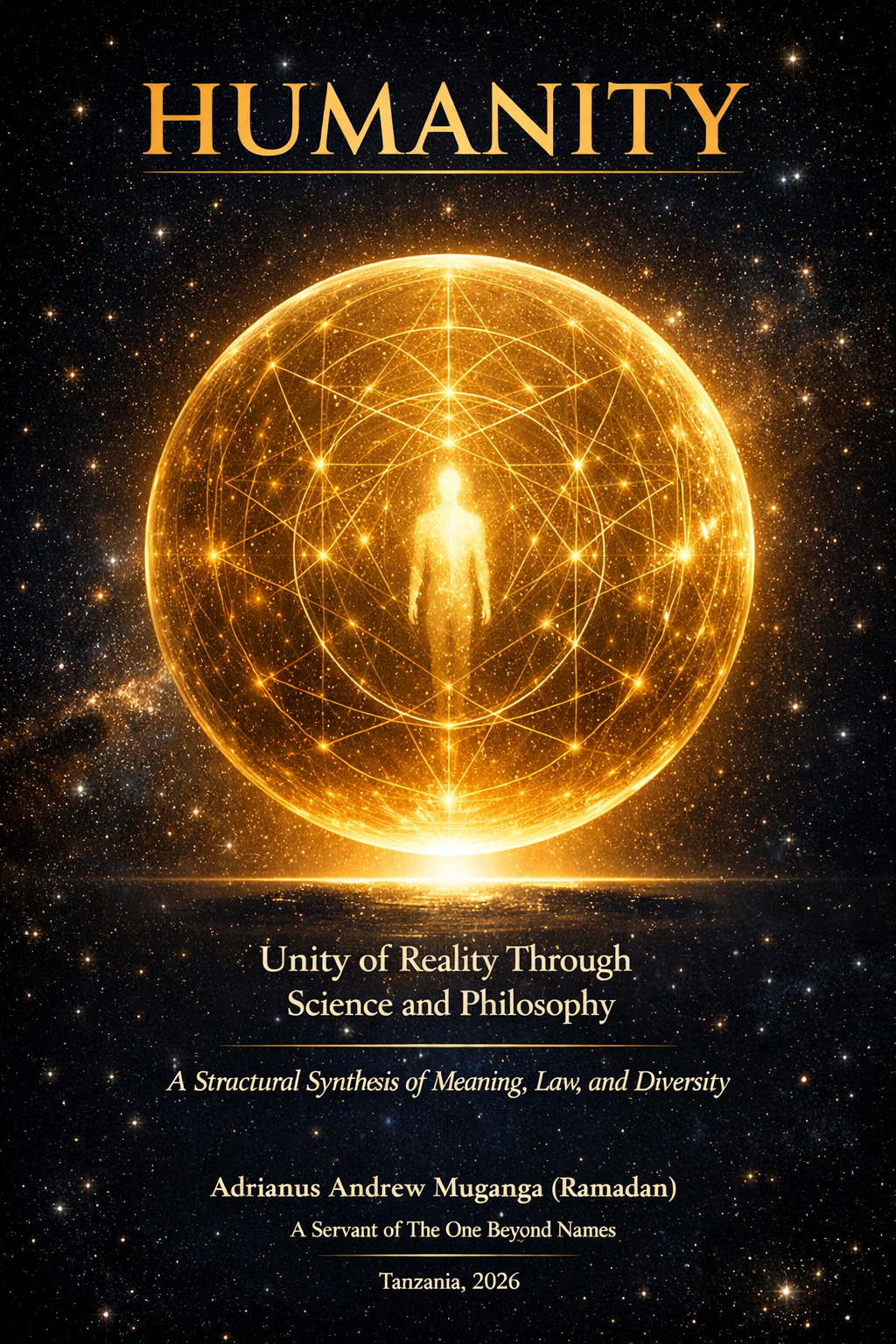
Humanity: Unity of Reality Through Science and Philosophy: We live in an age of unprecedented knowledge, and unprecedented fragmentation. Science advances with extraordinary precision, mapping the mechanisms of the universe from subatomic particles to cosmic expansion. Religion continues to shape moral orientation and existential meaning for billions. Philosophy interrogates logic, knowledge, and being itself. Yet these domains often operate as if separated by unbridgeable divides. The result is not intellectual richness, but confusion: mechanism without meaning, belief without structure, and reflection without grounding.
Humanity: Unity of Reality Through Science and Philosophy confronts this crisis at its root. Rather than choosing sides in familiar debates, it asks a deeper question: What makes understanding possible at all?
The book begins by diagnosing the fracture of modern thought. It examines how science, religion, and philosophy became compartmentalized each powerful within its domain, yet destabilized when isolated from the others. Scientific reductionism attempts to explain all reality through mechanism alone. Religious fideism detaches belief from rational structure. Philosophical skepticism questions the very possibility of grounding. These tendencies, though historically understandable, produce a divided intellectual landscape.
But the division, this work argues, is not inherent to reality itself. It arises from category mistakes.
Science explains mechanism: how processes unfold according to stable laws. Religion addresses meaning: why existence matters and how human life is oriented. Philosophy investigates grounding: what must be true for knowledge, law, and meaning to cohere. When these domains are confused, when mechanism is expected to produce moral purpose, or faith is asked to replace empirical inquiry, conflict emerges. When their structural roles are clarified, coherence becomes possible.
At the heart of the book lies a bold thesis: reality is intelligible because it is unified.
The stability of natural law, the applicability of mathematics to physical phenomena, the reliability of rational cognition, and the persistence of moral awareness are not disconnected facts. They are converging indicators of a deeper structural order. The universe is not merely observable, it is comprehensible. And this comprehensibility demands philosophical attention.
Why does mathematics so precisely describe physical reality? Why do logical principles remain invariant across cultures and centuries? Why can human cognition reliably discover truths about a cosmos vastly larger than itself? These are not peripheral curiosities. They are foundational questions. The book argues that intelligibility is not accidental; it is structural.
Drawing from metaphysics, epistemology, and philosophy of science, Humanity develops an integrated framework in which diversity is preserved within unity. It does not dissolve science into theology, nor does it reduce meaning to biology. Instead, it articulates the proper explanatory scope of each domain while showing how they participate in a single intelligible order.
The argument unfolds systematically. First, the fracture is analyzed historically and conceptually. Next, the conditions of intelligibility are examined: lawfulness, rational consistency, mathematical structure, and cognitive reliability. From there, the work turns to grounding, asking what must be true of reality for such coherence to exist. The final sections explore the implications of unity for human responsibility, knowledge, and civilizational stability.
Importantly, this book is not a devotional treatise, nor is it a polemic against science. It does not appeal to authority or tradition as substitutes for reasoning. Instead, it proceeds through careful structural analysis, distinguishing categories and clarifying assumptions. It invites readers to consider whether the persistent conflicts of modern thought are symptoms of misalignment rather than evidence of irreconcilability.
The implications extend beyond academic debate. If reality is fundamentally fragmented, then knowledge becomes provisional at its core, and competing worldviews cannot share common ground. But if reality is structurally unified, then dialogue, discovery, and moral responsibility rest on stable foundations. Civilizations depend not only on technological power, but on conceptual coherence.
Humanity therefore addresses both the scholar and the serious reader. It speaks to philosophers concerned with metaphysical grounding, to scientists interested in the philosophical implications of law and order, to theologians reflecting on rational structure, and to seekers who sense that truth must ultimately converge rather than contradict itself.
This work does not claim to exhaust the mystery of existence. Rather, it proposes that mystery itself presupposes order. The unknown can be explored precisely because reality is not chaos. Inquiry is meaningful because intelligibility is real.
At a time when polarization defines public discourse and specialization fragments understanding, Humanity: Unity of Reality Through Science and Philosophy offers a disciplined attempt to restore structural clarity. It challenges the assumption that unity requires uniformity or that diversity implies division. Instead, it argues that multiplicity is intelligible only within coherence.
The question the book leaves with the reader is both philosophical and practical:
Is the universe ultimately divided, or does its intelligibility point toward a deeper unity?
In pursuing this question, the work invites a reorientation not toward ideology, but toward coherence; not toward conflict, but toward clarity; not toward simplification, but toward structural understanding.
The future of knowledge may depend less on accumulating more information and more on rediscovering the unity that makes knowledge possible.
#Metaphysics
#Epistemology
#Philosophy Of Science
#Ontology
#Intelligibility
#Unity Of Knowledge
#Science And Religion
#Structural Realism
#Rationality
#Foundations Of Reason
#Coherence Theory
#Natural Law
#Category Theory
#Civilizational Philosophy
#Integration Of Knowledge
#Philosophy Of Mind
#Realism
#Metaphysical Grounding
#Logic
#Philosophy Of Reality
#Unity Of Reality
#Structural Coherence
#Grounding
#Rational Order
#Category Mistake
#Philosophy Of Knowledge
#Law And Order
#Civilizational Thought
#Structural Philosophy













_ebookfrontcover.jpeg)