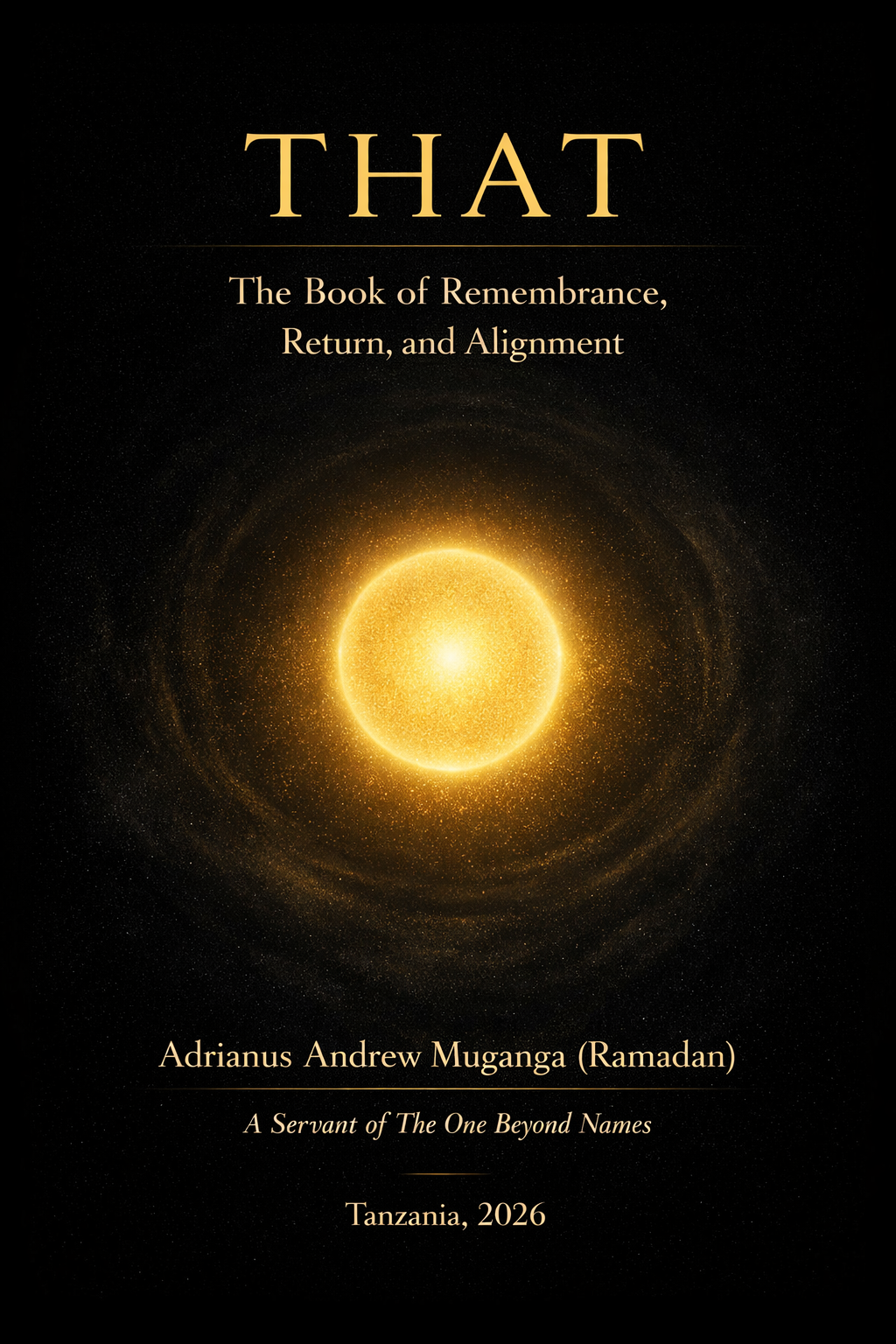
THAT: A Book of Remembrance and Return is a philosophical and contemplative inquiry into the nature of reality, identity, and continuity in an age defined by speed, fragmentation, and existential uncertainty. It argues that modern confusion does not arise from a lack of information, but from a subtle and deeply embedded misunderstanding: the elevation of visible form over the unexamined ground that makes all form possible.
The book opens by diagnosing what it calls “the forgetting.” This forgetting is not ignorance in the ordinary sense, but a shift in perception. Over time, human attention became increasingly trained on what is visible, measurable, nameable, and controllable. Forms objects, identities, systems, beliefs came to be treated as primary. What is unformed, constant, and enabling was gradually overlooked. Emptiness came to mean nothingness. Silence came to mean absence. Space came to be understood as void. In this interpretive shift, the foundation of experience was mistaken for lack.
Through careful examination, the book challenges these assumptions. Emptiness is reframed not as nonexistence, but as the absence of fixed form the open condition that allows form to arise. Silence is shown to be not the opposite of sound, but the ever-present background that makes sound distinguishable. Space is presented not as empty separation, but as a structured and connective field within which all movement and relation occur. Drawing parallels with modern scientific insights such as field theory and conservation principles the work demonstrates that what was once assumed to be void is consistently revealed to be structured, continuous, and active.
From this correction emerges a broader argument: reality is not composed of disconnected parts interacting across emptiness. It is a continuous whole within which forms appear, transform, and dissolve. Nothing enters it. Nothing leaves it. What changes is form; what remains is the unbroken ground in which change unfolds.
The book then traces how form “took the throne.” Visibility became equated with truth. Naming replaced direct seeing. Symbols, once transparent pointers toward deeper realities, hardened into objects of attachment and defense. As these developments accumulated, separation came to be assumed as fundamental. Individuals appeared isolated. Meaning appeared external. The source of existence was imagined as distant or outside the world it sustains.
This assumption of separation gave rise to a quiet but pervasive fear. The book examines how fear of loss, fear of endings, and fear of disconnection shape human behavior beneath the surface. Much of what is called ambition, devotion, accumulation, or even spiritual seeking is influenced by the underlying belief that something essential can be lost. If form is treated as the foundation of existence, then its disappearance appears final. In this context, fear is not irrational it is logical. The problem lies not in fear itself, but in the assumptions that generate it.
In its central sections, THAT proposes an alternative understanding grounded in continuity. Across spiritual traditions Islamic theology, Hindu philosophy, Buddhist insight and scientific observation, a converging recognition appears: reality is whole, without outside or division. What has been described as Allah, Brahman, emptiness, or the unified field points toward the same structural truth. These are not competing metaphysical claims, but differing languages attempting to articulate a reality that precedes language itself.
The book reframes the idea of “the Supreme.” It is not presented as a being among beings, nor as an external ruler acting upon creation. Instead, the Supreme is identified as the whole itself without boundary, hierarchy, or separation. Creation, preservation, and dissolution are not separate acts performed by separate agents, but movements within a single, continuous field of existence. From this perspective, nothing is ever truly lost; form dissolves, but the ground from which it arose remains unchanged.
Importantly, the work does not ask the reader to adopt a belief system or abandon existing traditions. It emphasizes direct examination rather than ideological commitment. Remembrance, in this context, is not emotional intensity or nostalgic return. It is the recognition of what has never been absent. Return does not mean traveling from one place to another; it means the correction of misunderstanding. Alignment is not conformity to doctrine, but living in coherence with reality as it is.
The later chapters move from metaphysical clarification to practical implication. If reality is whole and continuous, then identity becomes less defensive. Action becomes less reactive. Fear loses some of its grip. Responsibility deepens. The book explores what it calls “living from ground” acting without attachment to possession, loving without clinging, facing death without interpreting it as absolute loss. Discipline, relational integrity, and generational accountability emerge naturally from this orientation. Stability does not come from control, but from recognition of continuity.
The final section refuses dramatic closure. There is no final doctrine, no authority to obey, no system to defend. What remains when the book ends is silence not as emptiness, but as presence. The reader is invited to sit with the recognition that nothing new has been introduced. What has been offered is clarification, not invention.
Throughout, the writing maintains a deliberate simplicity. The argument unfolds step by step, building from misinterpretation toward coherence. Religious and scientific references are used not as proofs to be imposed, but as witnesses to convergence. The tone is neither mystical nor reductive; it seeks clarity without spectacle.
Ultimately, THAT: A Book of Remembrance and Return is not a manifesto, nor a theological system. It is a work of philosophical alignment. It addresses a generation overwhelmed by information yet uncertain of meaning, suggesting that what is sought has not been absent only overlooked. It calls readers not to adopt new identities, but to examine the ground of their own awareness with honesty and attention.
Its central claim is simple but far-reaching: reality is whole, continuous, and without outside. When this is recognized, fear softens, seeking clarifies, and action becomes coherent. What remains is not a new belief, but a restored orientation.
And from that orientation, return is already complete.
#Metaphysics
#Nonduality
#Consciousness
#Ontology
#Comparative Religion
#Spiritual Philosophy
#Unity
#Identity
#Reality Studies
#Philosophy Of Science
#Existential Inquiry
#Ethics



_ebookfrontcover.jpeg)