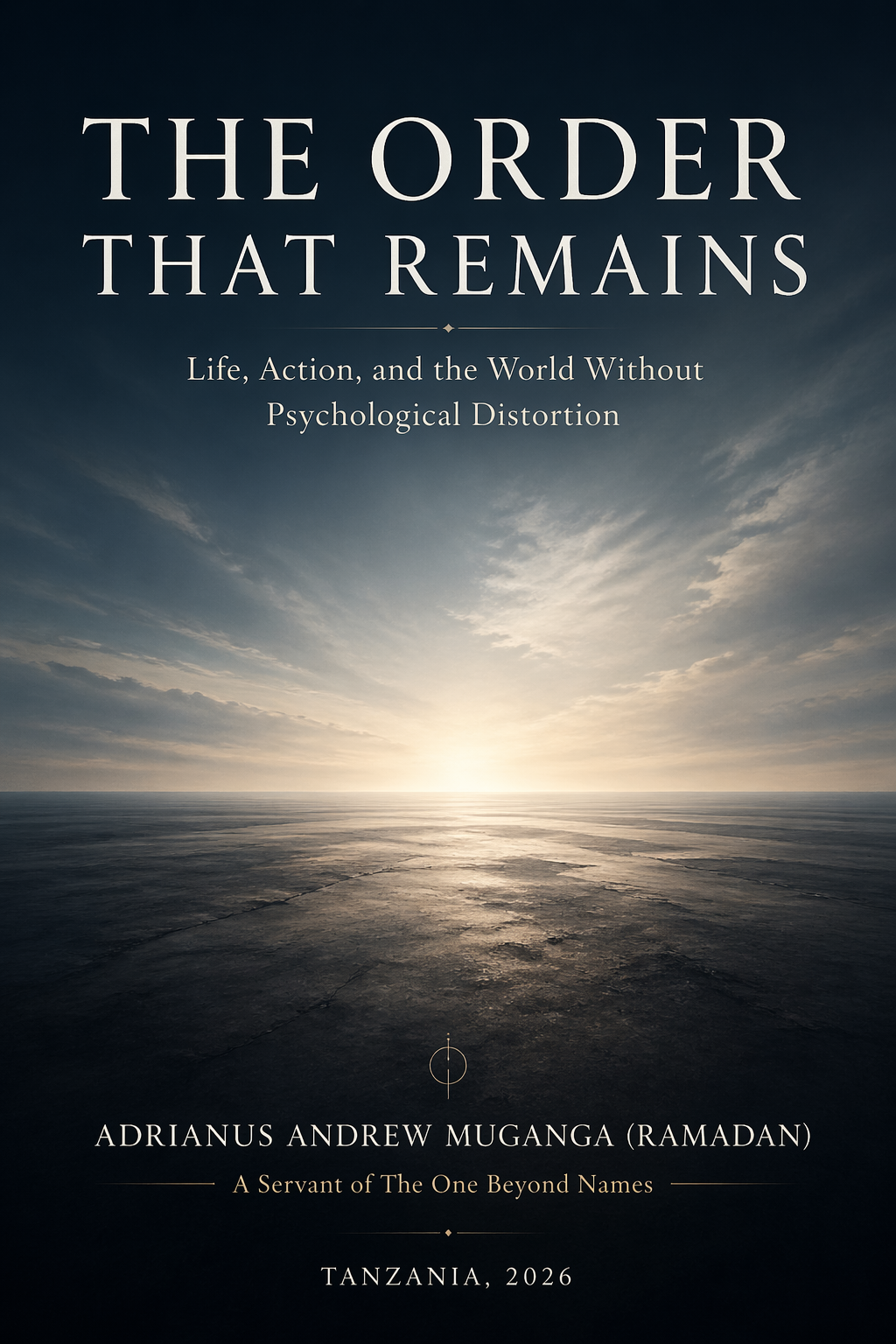
The Order That Remains: Life, Action, and the World Without Psychological Distortion. This work is not written to instruct, guide, or transform. It does not present a system, a philosophy, or a method to follow. It does not build toward conclusions or offer solutions to be applied. Instead, it remains entirely within direct observation, looking at human life as it is, without interpretation, without projection, and without the movement of becoming.
At the center of the book is a simple but often overlooked fact: human experience is shaped by psychological distortion. This distortion is not an abstract concept or a specialized condition. It is present in everyday life, in the way thought constructs identity, in the way memory shapes perception, and in the way division is created between oneself and others. What is commonly taken as normal experience is, in fact, structured through this distortion.
The book begins by examining the formation of the psychological self. Identity is shown not as something inherent or fixed, but as a construction built from memory, experience, and accumulated knowledge. This construction operates continuously, defining what one is, what one is not, and how one relates to the world. From this identification arises comparison, defense, fear, and the constant need for validation and continuity.
Where there is identity, there is division. The separation between “self” and “other” is not merely social or physical, but psychological. This division creates conflict, both internally and externally. Internally, it appears as contradiction, struggle, and dissatisfaction. Externally, it manifests as disagreement, competition, and fragmentation in relationship. The book does not treat these as issues to resolve, but as consequences of a deeper movement that must be seen clearly.
Thought plays a central role in this process. It is not presented as something to be controlled or eliminated, but as a functional tool that has moved beyond its proper place. Thought, when operating in the psychological domain, creates images, narratives, and projections that are mistaken for reality. It sustains the sense of self, reinforces division, and perpetuates conflict. The problem is not thought itself, but the misplacement of thought as the authority over perception.
The book continues by examining relationship, not as an ideal to be achieved, but as it actually unfolds. Relationship is shown to be shaped by images held about oneself and others. These images, formed through past experience and interpretation, interfere with direct perception. As a result, one does not relate to another person directly, but to the image one has constructed. This prevents genuine contact and sustains misunderstanding and conflict.
Action is also explored in depth. What is commonly called action is often driven by motive, reward, fear, or the desire for psychological gain. In this movement, action becomes a continuation of the self. It accumulates, reinforces identity, and seeks outcomes that sustain psychological continuity. The book reveals that where action is rooted in the self, it carries the imprint of distortion and therefore cannot be free of conflict.
Beyond the individual and relationship, the book expands into larger structures such as systems, economy, and the global human condition. These are not treated as separate domains, but as extensions of the same psychological movement. Systems are shaped by the individuals who create and maintain them. Where there is ambition, fear, comparison, and division within individuals, these same qualities become embedded in institutions, governance, and economic structures.
Corruption, inequality, and disorder are not presented as isolated problems, but as natural outcomes of a distorted psychological foundation. Attempts to reform systems without addressing the underlying movement of the self only produce modified forms of the same disorder. The book does not propose solutions or reforms, but shows that without clarity at the level of perception, structural change remains superficial.
As the examination deepens, the book begins to reveal what remains when psychological distortion is not operating. This is not introduced as an achievement, a state to reach, or a condition to cultivate. It is not the result of effort, discipline, or practice. It is simply what is present when the movement of distortion is absent.
In this absence, there is no center as identity. There is no accumulation of psychological experience. There is no division between observer and observed. Perception is direct, without the interference of memory projecting itself onto the present. In such clarity, action is not driven by motive or reward. It does not seek psychological gain or continuity. It is complete in itself.
Relationship, in the absence of image, is no longer mediated by past interpretations. There is no comparison, no expectation, and no psychological distance. Contact is immediate, and therefore free of conflict. This is not an ideal form of relationship, but the natural state when distortion is not present.
At the level of the world, the absence of psychological distortion implies a different foundation for human systems. Without division as identity, there is no basis for conflict as it is currently known. Without fear and accumulation as driving forces, the structures that emerge are not shaped by competition or control. This is not described as a blueprint for a future society, but as a direct consequence of clarity at the level of the individual.
Throughout the book, there is a consistent refusal to provide direction. Nothing is suggested as a practice. Nothing is offered as a belief. There is no authority to follow and no conclusion to accept. The text does not move toward persuasion or agreement. It remains descriptive, allowing the reader to see or not see what is being pointed to.
This approach places full responsibility on the reader. There is no external guidance, no step-by-step progression, and no assurance of outcome. The seeing must be direct, without reliance on the text as an authority. If what is described is seen clearly, it is not because of the book, but because the distortion that obscures perception is no longer operating in that moment.
The title, The Order That Remains, points to something fundamental. Order is not created through effort, control, or discipline. It is not imposed or constructed. It remains when disorder, which is born of psychological distortion, is not present. This order is not an idea or an ideal. It is the natural state of life when it is not shaped by the movements of the self.
This work stands outside the framework of conventional knowledge, self-improvement, and philosophical inquiry. It does not belong to any tradition, nor does it seek to establish one. It is a sustained act of observation, held without conclusion, without direction, and without motive.
There is nothing here to follow. There is nothing to become. There is only what is seen, or not seen, in the immediacy of one’s own life.
#Psychological Distortion
#Direct Observation
#Human Consciousness
#Self Identity
#Awareness
#Perception
#Inner Conflict
#Thought Process
#Human Behavior
#Non Duality
#Clarity
#Reality
#Conditioning
#Ego
#Observation
#Attention
#Mental Patterns
#Perception Of Reality
#Action Without Self
#Consciousness Exploration











_ebookfrontcover.jpeg)