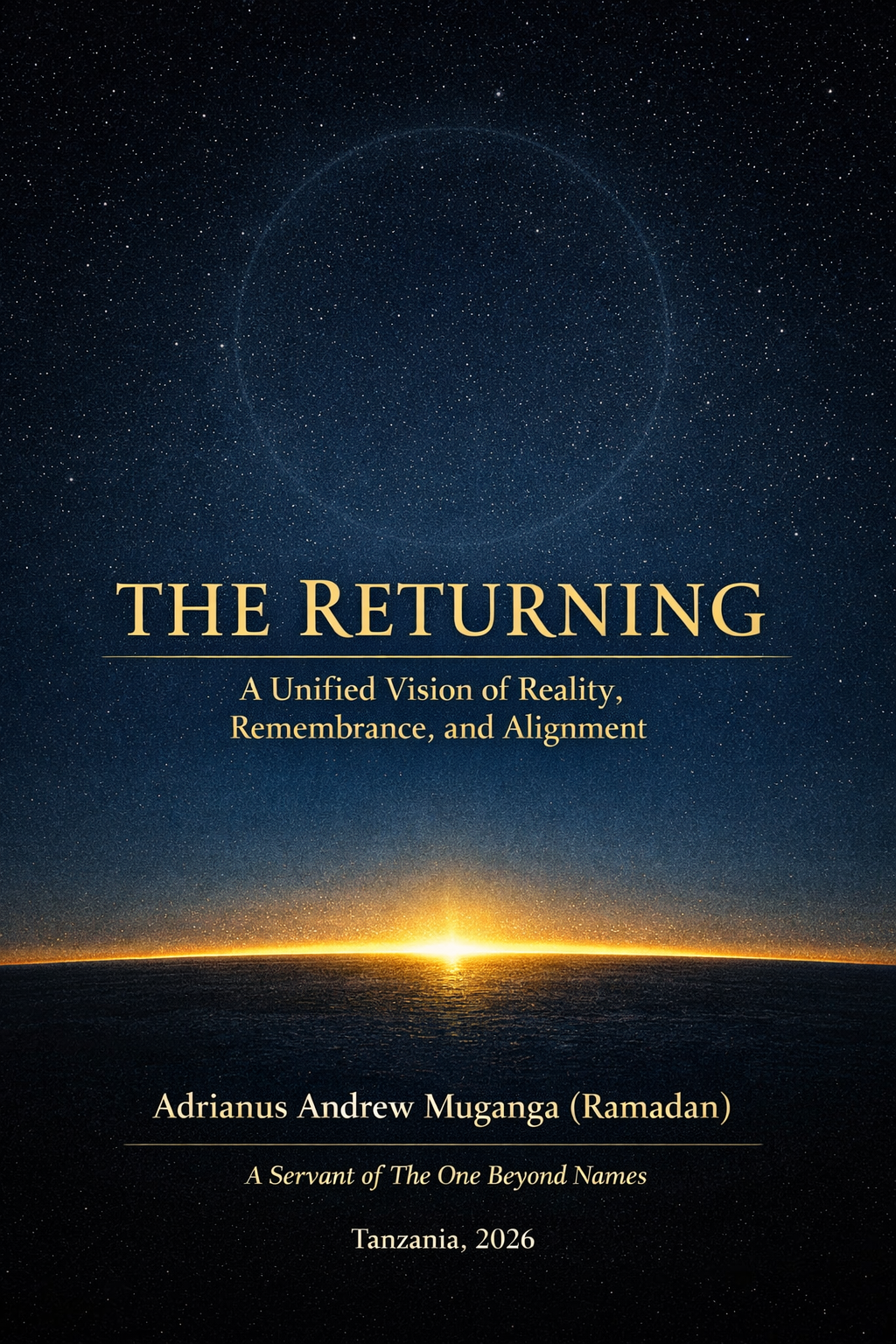
THE RETURNING: A Unified Vision of Reality, Remembrance, and Alignment is a systematic philosophical inquiry into the persistent instability that characterizes both individual experience and collective life. Despite technological progress, intellectual expansion, and institutional reform, a subtle but recurring tension remains within human consciousness. Societies evolve, ideologies shift, and knowledge accumulates, yet fragmentation endures. This work examines whether such instability is accidental or structural.
The book begins with direct observation rather than doctrine. It identifies a common internal condition: a sense of incompleteness that persists beneath achievement. Material stability, social recognition, and even spiritual participation often provide temporary satisfaction, but do not produce lasting coherence. The search continues. Goals are replaced. Standards shift. Fulfillment remains slightly beyond reach. This recurring cycle suggests that the source of tension may not lie in external deficiency but in the structure through which identity is formed and interpreted.
The analysis then turns inward to examine the construction of personal identity. Through memory, language, and social conditioning, a narrative self develops. This narrative organizes experience into continuity across time. While necessary for practical functioning, the narrative can solidify into a psychological center experienced as fundamentally separate from others and from reality itself. Perception divides experience into subject and object. What begins as functional differentiation can become existential separation.
This perceived separation stabilizes through reinforcement. Social roles, comparison, and defensive interpretation strengthen the narrative of “I.” Identity becomes something that must be protected. Validation confirms existence; criticism threatens it. As the narrative self becomes central, comparison intensifies and the sense of lack persists. The instability described at the outset is thus linked to the structure of separation embedded within perception.
The work then expands the analysis to collective systems. Societies are aggregations of individuals operating within shared assumptions. When identity is constructed through separation, institutions reflect that fragmentation. Systems of meaning religious, political, cultural can become fused with identity rather than oriented toward truth. Belief becomes a marker of belonging. Disagreement becomes threat. Power structures form around the preservation of narrative stability, and fear reinforces division. Collective polarization mirrors internal fragmentation.
Having traced instability from the individual to the societal level, the book examines the limits of external solutions. Reform, knowledge accumulation, and measurable progress are acknowledged as valuable but insufficient. Laws can change, institutions can restructure, and information can expand, yet if perception remains organized around separation, new systems replicate old patterns. Expansion without coherence magnifies distortion rather than resolving it. The root issue, the text argues, lies deeper than policy or productivity. It lies in alignment.
The second half of the work shifts from diagnosis to structure. If fragmentation is misalignment, alignment presupposes order. The book therefore examines whether reality itself operates according to coherent structure. Through observation of physical, biological, and relational systems, it argues that beneath variation lies consistency. Consequence functions as structural feedback rather than arbitrary punishment. Instability is not random; it reflects deviation from coherent relational order.
This principle is articulated as the Law of Alignment. The Law does not refer to religious command or institutional regulation. It describes the structural agreement between perception, action, and the inherent coherence of reality. When perception accurately reflects relational interdependence, action integrates. When perception is distorted by separation, action generates friction. Suffering, in this framework, is not moral condemnation but feedback within a lawful system.
The text proceeds to examine distortion and its mechanics. Cognitive misperception, emotional reinforcement, and institutionalized narratives sustain misalignment. These distortions are not treated as personal failures but as structural errors in interpretation. Responsibility is reframed accordingly. Instead of blame, the focus shifts to correction through clarity. Alignment becomes a practical process rather than an abstract ideal.
A significant portion of the work revisits theological concepts through structural analysis. The Divine is examined not as a projection of human identity but as the absolute coherence underlying existence. Anthropomorphic and tribal interpretations are identified as extensions of separation. Transcendence is reframed without mythology, and worship is understood as structural alignment rather than ritual compliance. Devotion becomes agreement with reality rather than performance of identity.
The book then considers restoration at scale. Polar distortions imbalances expressed culturally and psychologically are analyzed as reflections of fragmented perception. Ecological responsibility, institutional reform, and collective humility are presented as natural outcomes of alignment rather than ideological programs. Systems, the text argues, mirror consciousness. Structural clarity at the level of perception influences collective organization.
In its final movement, the argument is reduced to its simplest expression. The perceived distance between observer and observed dissolves under examination. The assumption of intermediary layers between human awareness and reality is questioned. What remains is direct coherence. “Returning” is defined not as movement toward a new state, but as cessation of distortion. “Remembrance” signifies recognition of structural unity that has never been absent.
The conclusion does not culminate in dramatic revelation. It rests in stabilization. When perception aligns with coherent order, internal contradiction diminishes. Action becomes consistent with structure. Stillness arises not as achievement, but as consequence.
Throughout, the work avoids rhetorical intensity and ideological persuasion. It does not argue for conversion, affiliation, or superiority. It proceeds through analysis, inviting readers to examine foundational assumptions about self, society, and existence. Agreement is not demanded; examination is required.
The Returning ultimately proposes that human instability is neither inevitable nor accidental. It is structural. And what is structural can be clarified. Alignment is not imposed from outside; it is recognized through disciplined perception. The resolution sought through accumulation, reform, or expansion may instead lie in the quiet correction of how reality is interpreted.
The book stands as a philosophical exploration for those willing to question the stability of identity, the coherence of perception, and the nature of reality itself. Its message is neither revolutionary nor mystical. It is precise: fragmentation arises from misalignment, and alignment restores coherence.
#Philosophical Metaphysics
#Structural Reality
#Identity And Perception
#Unity And Separation
#Law Of Alignment
#Coherent Order
#Consciousness And Reality
#Self And Narrative Identity
#Spiritual Philosophy
#Existential Inquiry
#Remembrance And Alignment
#Nondual Reflection
#Perception And Distortion
#Collective Fragmentation
#Reality And Coherence











_ebookfrontcover.jpeg)