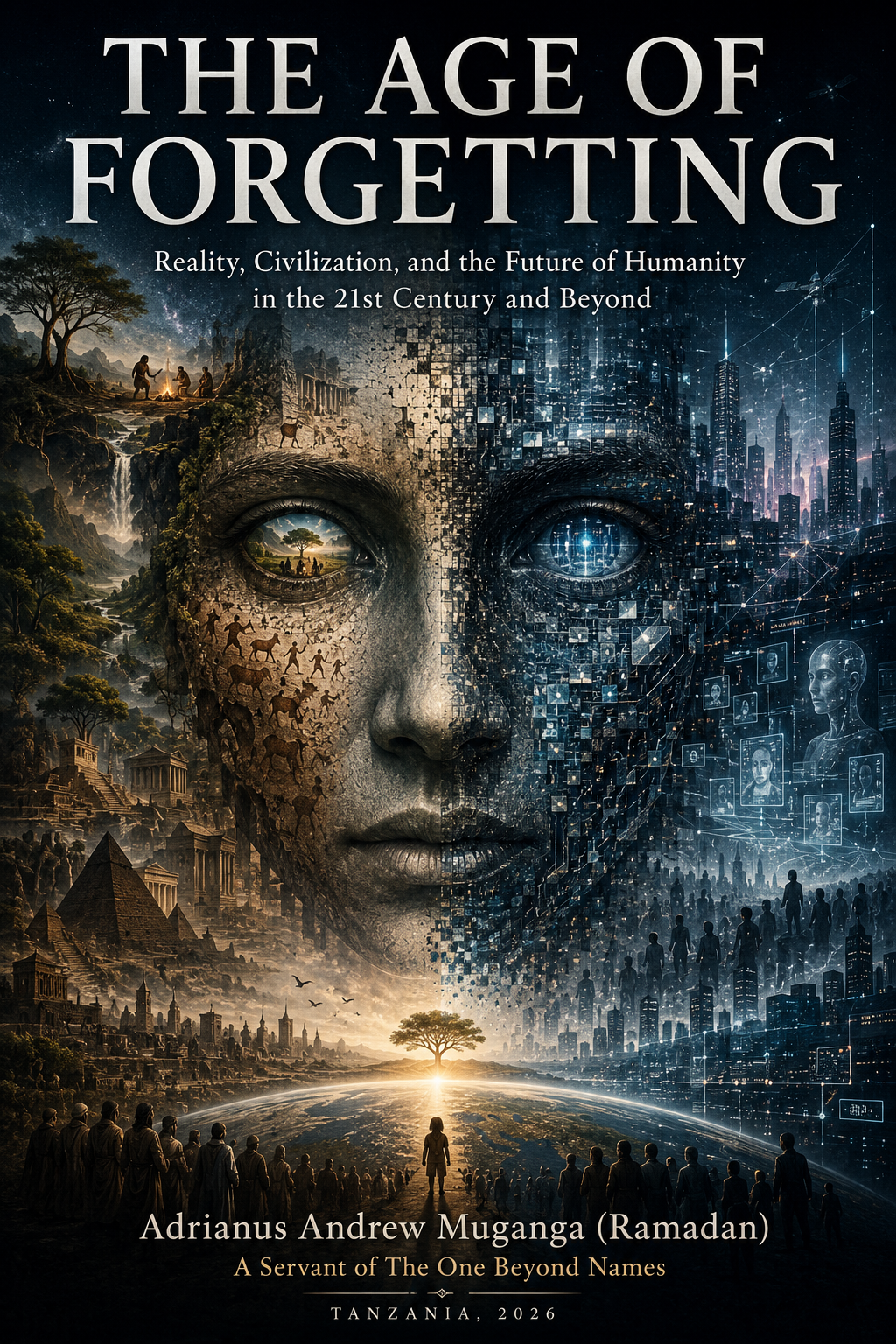
The Age of Forgetting: Reality, Civilization, and the Future of Humanity in the 21st Century and Beyond is a long-range civilizational examination of humanity during one of the most transformative periods in recorded history. The book explores the accelerating changes reshaping human civilization across psychology, technology, economics, governance, identity, family structures, artificial intelligence, digital systems, and the future architecture of society itself. Rather than focusing narrowly on politics or temporary cultural conflict, the work approaches humanity as one continuous civilizational story extending from early human origins to the emerging planetary civilization of the twenty-first century and beyond.
The central argument of the book is that modern civilization is entering a period of unprecedented acceleration while increasingly forgetting the sustaining realities that historically allowed human societies to remain psychologically stable, socially coherent, morally grounded, and biologically continuous across generations. Humanity has gained extraordinary technological capability, yet many societies simultaneously experience rising loneliness, fragmentation, identity instability, institutional distrust, emotional exhaustion, demographic decline, weakening family systems, and increasing separation from direct human relationship and continuity structures. The book argues that the danger facing civilization is not technology alone, but technological advancement unfolding faster than humanity’s ability to remain aligned with the conditions necessary for long-term human flourishing.
The early chapters examine humanity across deep historical time, beginning with the biological, psychological, and relational realities that shaped early human survival. The work explores how cooperation, interdependence, family continuity, shared meaning systems, responsibility toward future generations, and stable social structures gradually allowed civilization to emerge over thousands of years. It argues that many sustaining conditions of civilization became so normalized throughout history that modern societies rarely stopped to examine them directly until fragmentation began weakening them under contemporary pressures.
The book then analyzes the rise of industrial civilization, globalization, digital systems, and artificial intelligence as part of what it describes as the “Great Acceleration.” It explores how technological systems increasingly shape identity, emotion, behavior, attention, communication, and social life at planetary scale. The work examines the transformation of human existence under conditions of permanent stimulation, algorithmic influence, social media visibility, commodified attention, and increasingly synthetic environments. It argues that human beings evolved psychologically under conditions very different from the environments now dominating modern civilization, creating growing tension between ancient human needs and rapidly accelerating artificial systems.
Several chapters focus on the fragmented condition of modern society. The book investigates rising loneliness, emotional instability, declining trust, identity fragmentation, performative digital culture, weakening community life, and the transformation of human relationship under technological mediation. It explores how attention economies increasingly reward outrage, stimulation, tribalism, and emotional reaction while weakening patience, continuity, reflection, and shared reality recognition. The work also examines how ideological conflict, algorithmic reinforcement, and digital tribalism have intensified polarization while making collective civilizational understanding increasingly difficult.
The book dedicates substantial attention to the future consequences of artificial intelligence, synthetic relationships, automation, demographic instability, technological dependency, and increasingly immersive digital systems. It explores how AI may reshape labor, education, governance, emotional attachment, creativity, identity formation, and the future structure of civilization itself. Rather than presenting purely utopian or dystopian narratives, the work approaches these developments through long-range civilizational observation, asking whether humanity possesses the psychological stability, ethical maturity, and long-term wisdom necessary to manage unprecedented technological power responsibly.
A major theme throughout the work is the distinction between advancement and wisdom. The book repeatedly argues that technological capability alone cannot sustain civilization without continuity, responsibility, meaning, and human coherence. It examines how societies throughout history often normalized destabilizing patterns before fully understanding their consequences. The work warns that civilizations may become increasingly technologically powerful while simultaneously weakening the relational, moral, and psychological foundations required for long-term stability.
The later sections of the book focus on remembrance, healing, and the future possibilities still available to humanity. These chapters explore principles necessary for restoring civilizational coherence, including reality before ideology, responsibility before consumption, relationship before isolation, wisdom before power, and continuity before acceleration. The work argues that humanity’s future depends not on rejecting technology, but on ensuring that technological systems remain aligned with human dignity, psychological stability, intergenerational continuity, embodiment, truth, and long-term flourishing.
The final chapters examine possible futures for the twenty-first century and beyond, including the emergence of planetary civilization, AI-mediated societies, synthetic environments, demographic transformation, and the future evolution of human identity itself. The book asks whether civilization can preserve meaning, freedom, cooperation, and human relationship while adapting to accelerating technological transformation. It concludes that humanity still possesses extraordinary capacity for adaptation, creativity, wisdom, and renewal, but only if societies regain the ability to observe reality honestly before fragmentation advances beyond reversal.
Written in a calm, observational, evidence-centered, and globally civilizational style, The Age of Forgetting is not a work of ideological warfare, fear, or condemnation. It is intended as a civilizational mirror encouraging humanity to think across generations rather than headlines, across systems rather than temporary political conflict, and across long-range consequence rather than short-term emotional reaction. The work ultimately asks one defining question: whether humanity can remain psychologically stable, morally grounded, relationally human, and sustainably coherent while entering an age of unprecedented technological acceleration and synthetic transformation.
#Civilization
#Artificial Intelligence
#Future Humanity
#Technology
#Psychology
#Digital Age
#Future Civilization
#Social Fragmentation
#Human Behavior
#Philosophy
#Cultural Change
#Ai And Society
#Loneliness
#Identity Crisis
#Technological Acceleration
#Modern Society
#Future Studies
#Anthropology
#Social Psychology
#Human Continuity