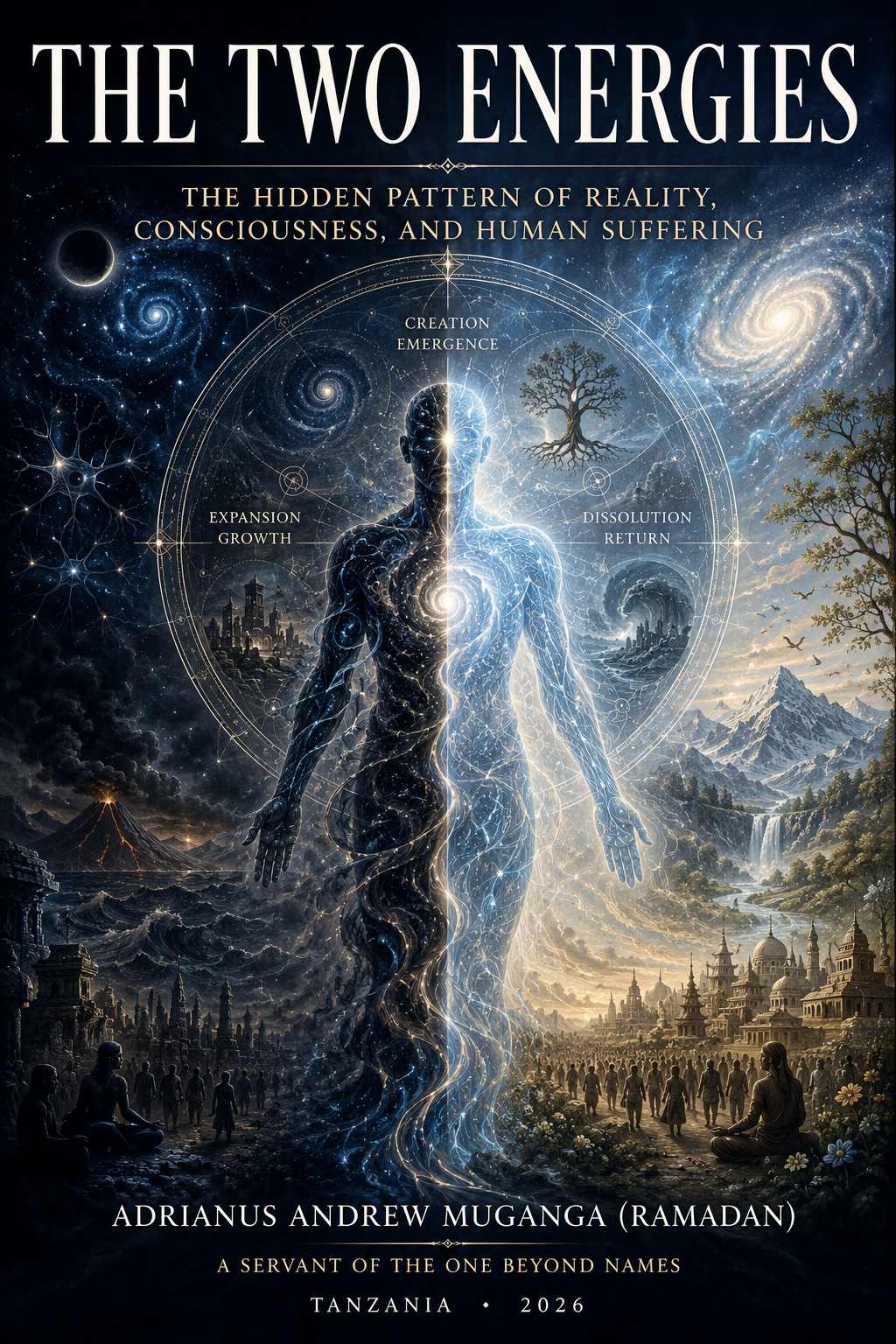
THE TWO ENERGIES: The Hidden Pattern of Reality, Consciousness, and Human Suffering. THE TWO ENERGIES is a sweeping philosophical, psychological, spiritual, and civilizational exploration into the hidden structural patterns underlying reality, human consciousness, suffering, transformation, and existence itself. Written in a powerful long-form style that bridges spirituality, science, psychology, cosmology, systems theory, and symbolic traditions, this work investigates one of the oldest recurring observations preserved across civilizations: that reality appears to operate through the dynamic relationship between two complementary movements or energies.
Throughout human history, different cultures, religions, and systems of knowledge attempted to describe these forces through different symbolic languages. Hindu philosophy expressed them through Shiva and Shakti, Ardhanarishvara, and the cosmic cycles of the Yugas. Taoism preserved them through Yin and Yang. Buddhism examined them through impermanence, attachment, balance, and observation. Mystical traditions explored them through inner transformation and surrender. Modern science studies them through systems, equilibrium, entropy, energetic exchange, cosmology, biological regulation, and the dynamics of complex living systems. Although the names differ, THE TWO ENERGIES proposes that many traditions were observing structurally related patterns operating throughout existence itself.
At the center of this work lies the exploration of two complementary principles: stillness and motion, consciousness and energy, order and transformation, structure and dissolution, preservation and renewal. The book argues that these movements are not enemies competing for dominance, but interdependent forces necessary for balance throughout nature, human psychology, civilizations, ecosystems, relationships, and cosmic processes. Much of human suffering, conflict, fear, psychological fragmentation, and civilizational collapse emerges when these forces become misunderstood, divided, or imbalanced.
Rather than promoting blind belief, ideology, dogma, or religious superiority, the book invites readers into disciplined observation. It challenges inherited divisions separating science from spirituality, psychology from philosophy, meaning from mechanism, and inner life from outer systems. It proposes that reality itself was never truly divided, but that human perception gradually became fragmented through institutionalization, fear, ideological attachment, literalism, and disconnection from direct observation.
Across its extensive chapters, THE TWO ENERGIES explores how ancient symbolic systems encoded profound insights into consciousness, balance, transformation, and cosmic movement. It examines symbolic archetypes such as Shiva, Shakti, Ardhanarishvara, Kali, Yin and Yang, cosmic cycles, meditation traditions, and transformative spiritual imagery not merely as objects of worship or mythology, but as structural representations of observable patterns operating throughout existence.
The book investigates why humanity repeatedly misunderstands destructive or transformative forces as absolute evil rather than recognizing their role within larger cycles of renewal, correction, growth, and balance. It examines how fear, attachment, imbalance, and fragmentation distort human perception, both individually and collectively. It also explores how civilizations collapse when technological power, political systems, economic expansion, and social structures become disconnected from deeper forms of psychological and ecological balance.
A major focus of the work centers on human consciousness itself. The book explores dreams, trauma, emotional regulation, nervous system balance, inner conflict, ego formation, fear, attention, psychological fragmentation, and healing through the lens of the two energies. It examines how the human mind mirrors larger cosmic and structural processes, proposing that the individual human being functions as a microcosm reflecting patterns visible throughout nature and civilization.
The work also investigates the relationship between modern science and ancient systems of observation. Drawing from neuroscience, cosmology, systems theory, ecology, psychology, and physics, THE TWO ENERGIES argues that scientific inquiry and contemplative traditions need not remain enemies. Science provides disciplined external observation and structural analysis, while contemplative and philosophical traditions preserve insights into consciousness, suffering, meaning, ethics, and direct human experience. The book proposes that humanity’s future may depend not on the victory of one system over another, but on restoring a deeper relationship between observation, wisdom, structure, and reality itself.
Throughout the text, readers are encouraged not merely to think intellectually about the ideas presented, but to observe the patterns directly within life itself: within relationships, emotions, civilizations, nature, social systems, cycles of exhaustion and renewal, inner conflict, healing, ecological imbalance, technological acceleration, and the movement of consciousness. The book repeatedly emphasizes recognition over belief. It does not ask readers to become followers, adopt a new ideology, or surrender independent thought. Instead, it encourages careful observation, critical reflection, and direct engagement with reality.
The later sections of the work explore the future of humanity and the possibility of civilizational transformation. The book examines how imbalance within leadership, education, economics, technology, and collective identity contributes to growing global fragmentation, anxiety, ecological destruction, ideological extremism, and psychological instability. It proposes that humanity has reached a threshold where external advancement without inner balance increasingly produces crisis. Yet it also suggests that this moment of fragmentation may become an opportunity for deeper recognition and renewal.
Ultimately, THE TWO ENERGIES is a call for humanity to move beyond fear, inherited division, ideological rigidity, and fragmentation toward greater clarity, balance, responsibility, and alignment with reality itself. It presents a vision in which science, spirituality, philosophy, psychology, and human experience no longer function as isolated territories competing for authority, but as interconnected approaches attempting to understand the same underlying structures of existence.
Written in a statesmanlike, evidence-grounded, philosophically expansive, and spiritually profound style, this work is intended for readers interested in consciousness studies, metaphysics, spirituality, comparative religion, psychology, philosophy, symbolism, cosmology, systems thinking, human transformation, and the future of civilization. More than a philosophical work, THE TWO ENERGIES is an invitation to recognize the hidden continuity beneath separation and to observe reality more deeply, honestly, and completely. THE TWO ENERGIES is not a call toward blind belief. It is a call toward recognition.
#Consciousness
#Spirituality
#Philosophy
#Human Suffering
#Metaphysics









_ebookfrontcover.jpeg)