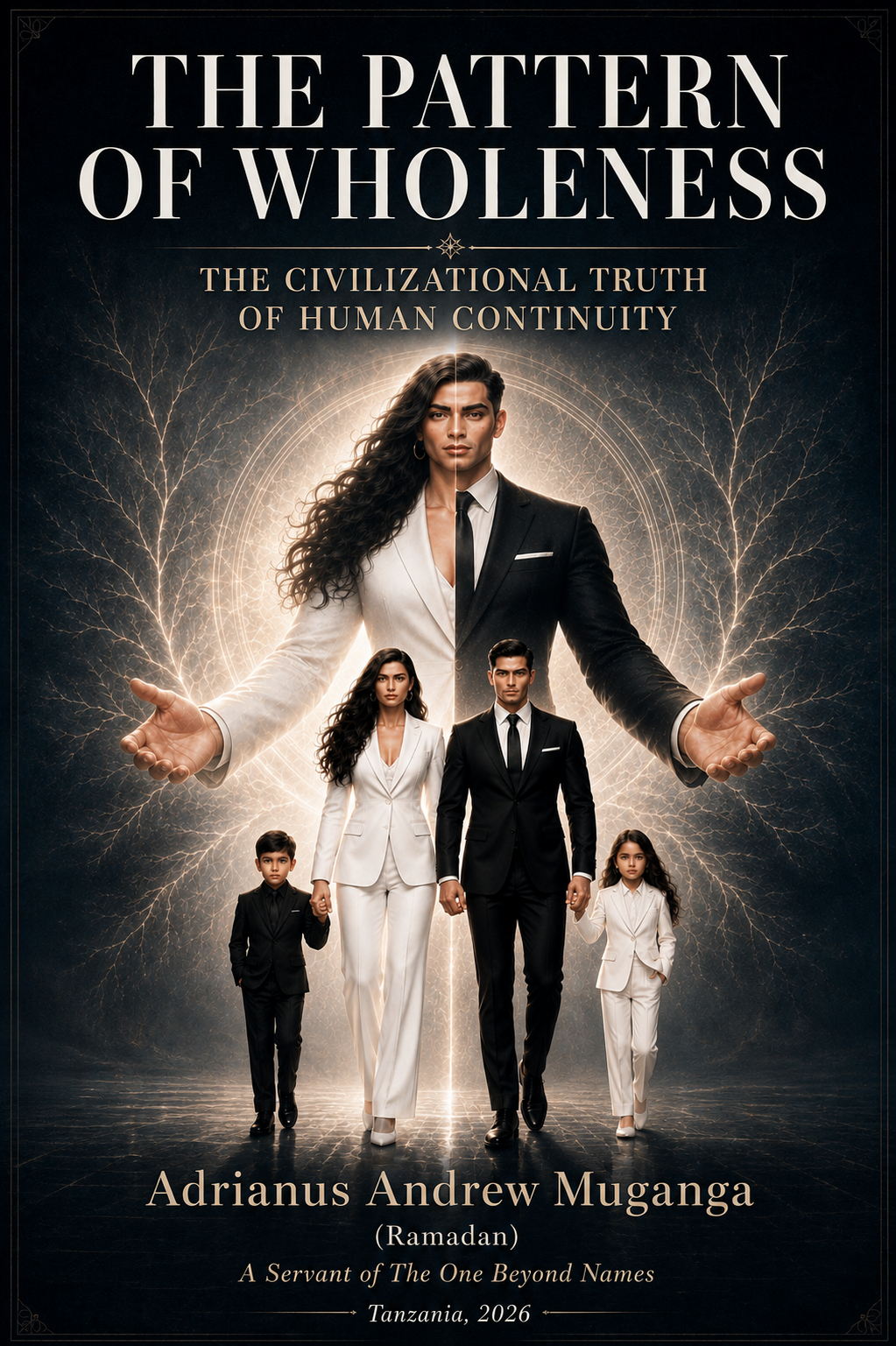
THE PATTERN OF WHOLENESS: The Civilizational Truth of Human Continuity
Subtitle: The Civilizational Truth Of Human Continuity
Author: Adrianus Muganga
THE PATTERN OF WHOLENESS: The Civilizational Truth of Human Continuity is a civilizational inquiry into the structural realities that sustain human continuity, relational balance, family stability, and social cohesion across generations. Drawing from Hindu symbolism, Genesis, Taoist philosophy, biology, neuroscience, attachment theory, natural systems, and historical analysis, Adrianus Andrew Muganga examines the recurring patterns that connect masculine and feminine participation within one integrated whole. The book argues that many modern crises, including relational instability, social fragmentation, declining trust, and weakening family continuity, reflect a deeper structural forgetting concerning human relationship and differentiated participation. Through disciplined observation and cross-cultural analysis, the work explores how civilizations preserved the recognition of wholeness, how distortion transformed difference into hierarchy and competition, and how recovery remains possible through structural realignment. Written in a statesmanlike voice, this work offers an evidence-grounded examination of the foundations necessary for enduring human continuity and civilizational stability.
Keywords for this book
You can only order 1 ebook at a time
Book summary
THE PATTERN OF WHOLENESS: The Civilizational Truth of Human Continuity is a comprehensive civilizational inquiry into the foundational structures that sustain human continuity, relational stability, social coherence, and intergenerational endurance. Written in a disciplined, statesmanlike voice, the work examines one of the defining questions of the modern age: what happens to civilization when humanity forgets the structural pattern through which differentiated human existence participates within one continuous whole? The book argues that many of the crises increasingly visible across modern societies, including relational instability, weakening family structures, declining social trust, fragmentation of identity, educational confusion, and widening cultural division, cannot be fully understood as isolated political, economic, or technological problems alone. Beneath these visible conditions lies a deeper structural forgetting concerning the nature of human participation, continuity, and relational order itself. The work proposes that civilizations endure only when aligned with realities that remain true independent of ideology, historical fashion, or institutional preference, and that the present century is increasingly confronting the consequences of separation from those realities. The inquiry begins by examining the symbolic memory preserved across civilizations concerning differentiated wholeness. Opening with the Hindu figure of Ardhanarishvara, one of the clearest symbolic representations of masculine and feminine principles united within one continuous whole, the book explores how ancient civilizations repeatedly preserved the recognition that creation, continuity, and relational coherence emerge not through isolated opposition, but through coordinated differentiation within integrated unity. From Hindu symbolism, the work expands outward into Genesis, Taoist philosophy, Greek thought, Kabbalistic structures, indigenous cosmologies, and other ancient traditions to investigate whether civilizations separated by geography, language, and history repeatedly converged upon similar structural recognitions. Rather than treating religions or civilizations as competitors for ownership of truth, the book approaches them as independent witnesses preserving fragments of recurring structural reality. The central concern is not theological comparison for its own sake, but the recognition that when independent traditions repeatedly preserve the same relational logic concerning continuity and complementary participation, recurrence itself becomes evidential. From symbolic memory, the inquiry moves into nature, biology, and science. The book examines how differentiated participation functions across natural systems, ecological balance, reproductive architecture, cooperative survival mechanisms, and developmental continuity. It argues that nature repeatedly demonstrates that distinction does not imply hierarchy and that continuity depends upon reciprocal participation among differentiated functions operating within larger integrated systems. Particular attention is given to the relationship between visible and hidden forms of contribution, challenging the historical tendency of civilizations to equate visible force or outward authority with greater significance while diminishing sustaining, developmental, relational, and generative functions that remain less outwardly dramatic yet indispensable to continuity itself. The work explores biological complementarity, genetic participation, neurobiological differentiation, attachment theory, emotional development, and cooperative intelligence, arguing that human continuity emerges not through isolated autonomy alone, but through coordinated relational structures that support development across generations. The book then turns toward the civilizational consequences of forgetting differentiated wholeness. It examines how historical distortions gradually transformed difference into hierarchy, competition, possession, and transactional interpretation. Over time, civilizations increasingly detached masculine and feminine participation from the larger continuity through which both derive meaning, leading to systems of imbalance, mistrust, relational fragmentation, and social instability. The work investigates how dominance structures emerged where visible force was mistaken for superior value, how sustaining forms of participation became culturally diminished, and how modern societies inherited fragmented frameworks concerning identity, relationship, responsibility, and human worth. These distortions are not approached as isolated moral failures or temporary social trends, but as manifestations of deeper structural misrecognition. The book argues that many contemporary conflicts surrounding gender, identity, relationship, and family are intensified because modern civilization often attempts to address symptoms while leaving the underlying fragmentation of structural perception unresolved. A major focus of the work concerns childhood formation, education, and intergenerational transmission. The inquiry explores how children inherit assumptions concerning masculine and feminine participation not primarily through formal doctrine, but through repeated social patterns, institutional narratives, family structures, and cultural conditioning. Where fragmentation becomes normalized, generations may grow increasingly unable to perceive differentiated wholeness except through categories of competition, superiority, inferiority, or ideological opposition. The book examines how educational systems, social narratives, and relational instability progressively shape the consciousness of future generations, arguing that structural confusion concerning human continuity eventually reproduces itself across civilizations unless interrupted by disciplined recognition. This concern leads into a broader examination of how family stability, attachment security, mutual responsibility, and relational coherence function as civilizational foundations rather than merely private social arrangements. Throughout the work, the method employed is described as structural recognition. Rather than beginning from ideological allegiance or predetermined doctrine, the inquiry proceeds through observation, convergence, comparison, and recurring pattern. The argument of the book does not rest upon isolated belief, selective historical interpretation, or political alignment. Instead, it examines whether symbolic traditions, biological systems, developmental psychology, natural law, and civilizational consequences repeatedly reveal the same underlying relational structure concerning human continuity. The book argues that where independent domains consistently converge upon the same foundational logic, the probability of structural truth increases significantly. This method allows the work to move beyond simplistic opposition between religion and science, tradition and modernity, or philosophy and biology, seeking instead an integrated understanding of the recurring realities governing continuity itself. In its later chapters, THE PATTERN OF WHOLENESS shifts from diagnosis toward recovery and realignment. The inquiry explores whether civilization can recover structural balance before fragmentation deepens beyond repair. It examines the possibility of rebuilding social trust, restoring relational reciprocity, renewing educational clarity, strengthening family continuity, and recovering a framework in which masculine and feminine participation are understood neither as interchangeable abstractions nor as hierarchical opposites, but as complementary forms of contribution within one integrated whole. The work argues that the future stability of civilization depends not merely upon technological innovation, economic systems, or institutional reform, but upon whether humanity can once again recognize the structural truths through which continuity itself becomes possible. At its center stands one foundational thesis: human continuity depends upon differentiated participation within one whole. Difference is real, functional, and necessary, but separation is distortion. Civilization remains stable only when relational participation operates within coherent wholeness rather than fragmentation. THE PATTERN OF WHOLENESS is therefore offered not as political manifesto, sectarian doctrine, or ideological reaction, but as an evidence-grounded civilizational inquiry into the enduring realities that govern relationship, continuity, and human existence itself. It invites readers not toward allegiance, but toward recognition.
Book details






_ebookfrontcover.png)