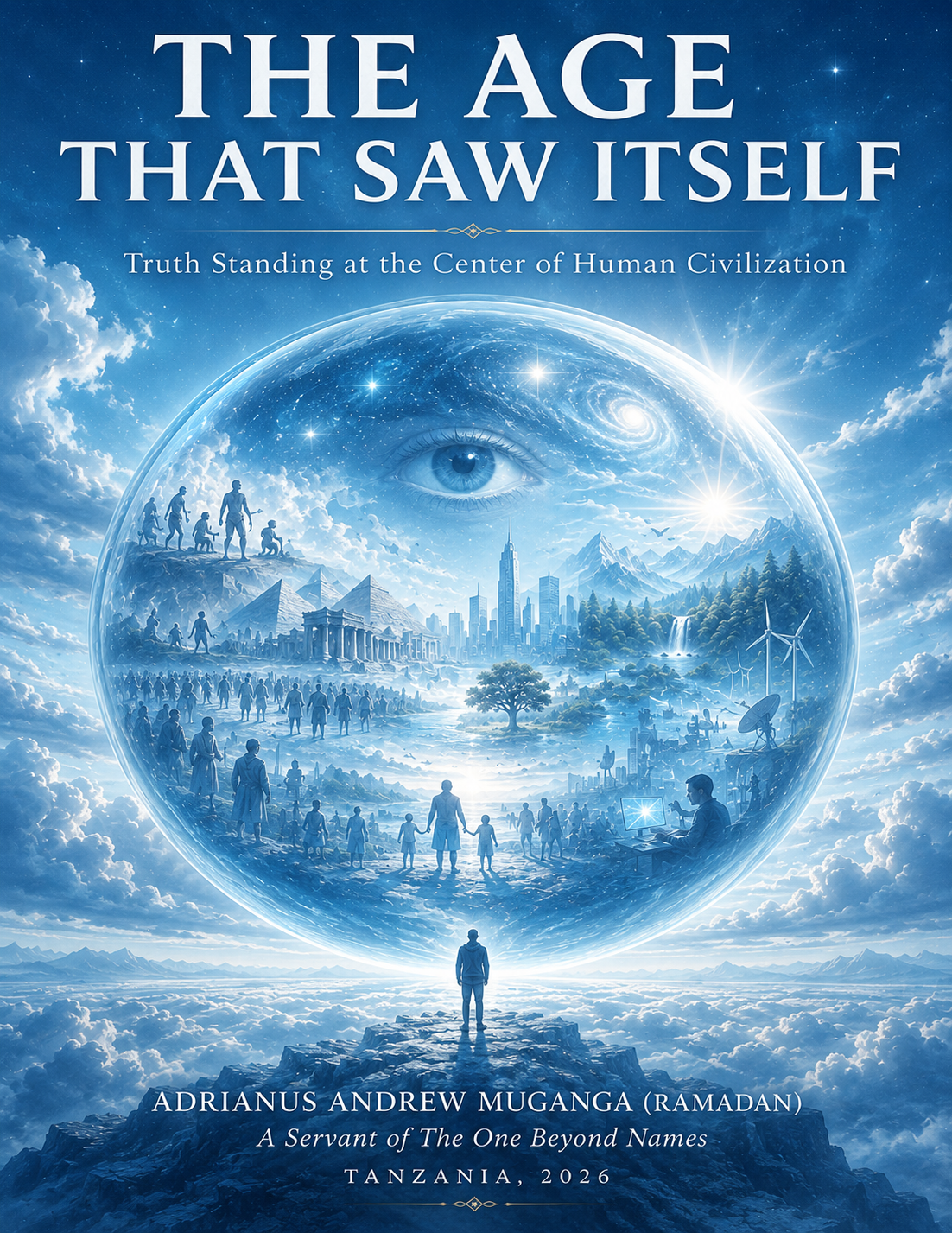
THE AGE THAT SAW ITSELF: Truth Standing at the Center of Human Civilization is a comprehensive examination of humanity at a pivotal moment in its history. The book argues that human civilization has entered a unique era in which, for the first time, humanity possesses the ability to observe itself as a single interconnected species. Through global communication, technological integration, scientific knowledge, economic interdependence, and shared ecological realities, the actions of individuals, institutions, and nations increasingly influence one another across planetary scales. As a result, humanity faces not only unprecedented opportunities but also unprecedented responsibilities.
Rather than presenting a political ideology, religious doctrine, philosophical system, or predictive prophecy, the book serves as a civilizational mirror. Its purpose is to encourage readers to examine reality directly by observing patterns that emerge across history, biology, psychology, relationships, societies, and civilizations. The work is grounded in the principle that truth exists independently of preference, belief, or ideology. Human beings may disagree about interpretations, but reality itself continues to operate according to principles that no opinion can permanently alter.
The book begins by exploring the human condition and the remarkable journey of humanity from small communities of survival to a technologically connected planetary civilization. It examines the achievements that have characterized human progress, including scientific discovery, medical advancement, economic development, cultural creativity, and the expansion of knowledge. At the same time, it recognizes that progress has always existed alongside recurring struggles involving conflict, inequality, fear, tribalism, and competition. Human history reveals both extraordinary capacities for cooperation and persistent tendencies toward division.
A central theme of the work is the concept of fragmentation. The book argues that many of the defining challenges of the modern age, including social polarization, loneliness, family instability, identity conflict, ecological degradation, information overload, institutional distrust, and political division, are interconnected expressions of fragmentation. While these challenges often appear separate, they frequently emerge from the same underlying tendency to perceive individuals, groups, and systems as isolated rather than interconnected. Fragmentation weakens relationships, disrupts social trust, and reduces humanity’s capacity to address complex challenges collectively.
The text further examines the relationship between individual psychology and broader social structures. Human perceptions, fears, desires, and identities shape institutions, cultures, and political systems. In turn, those systems influence individual behavior and consciousness. The book emphasizes that civilization is not separate from human beings; it is an expression of human thought, behavior, and relationships operating at larger scales. Therefore, lasting societal transformation cannot emerge solely from external reforms. It must also involve deeper forms of psychological and cultural development.
Another major focus of the book is the principle of interdependence. Across biology, ecosystems, families, economies, and civilizations, life functions through networks of relationships. No organism survives entirely alone, and no civilization develops independently of countless forms of cooperation. The work demonstrates that interdependence is not merely a moral preference but an observable reality embedded within the structure of living systems. Human flourishing depends upon the health of relationships between individuals, communities, institutions, and the natural world. When these relationships deteriorate, instability increases; when they strengthen, resilience emerges.
The book also explores the transformative impact of technology. Technological advancement has dramatically expanded human capabilities, enabling communication, innovation, and productivity on unprecedented scales. Yet technology alone cannot determine the direction of civilization. Powerful tools amplify human intentions, values, and decisions. As humanity gains greater technological power, questions concerning wisdom, responsibility, ethics, and long-term stewardship become increasingly important. The work argues that the future will be shaped not simply by what humanity can do, but by whether humanity develops the maturity necessary to guide its expanding capabilities responsibly.
A significant portion of the text examines consciousness, perception, and the ways in which human beings construct meaning. The book investigates how beliefs, narratives, identities, and mental frameworks influence the interpretation of reality. While perspectives vary across cultures and individuals, the work maintains that reality itself remains independent of perception. Growth occurs when human understanding becomes more closely aligned with observable reality rather than ideological abstraction. The pursuit of truth therefore requires humility, curiosity, self-examination, and openness to evidence.
Throughout the book, relationships are presented as one of the foundational structures of civilization. Families, friendships, communities, institutions, and societies are all built upon networks of human connection. The quality of these relationships influences personal well-being, social stability, cultural continuity, and collective resilience. The work argues that many contemporary crises cannot be understood solely through economic, political, or technological frameworks because they also involve the weakening of relational foundations. Strong societies emerge from healthy relationships, trust, responsibility, and shared commitments that extend across generations.
The book further considers humanity’s relationship with the natural world. Ecological systems sustain every aspect of civilization, yet modern societies often behave as though human activity exists independently of environmental realities. The text emphasizes that humanity is not separate from nature but part of a larger living system upon which all economic and social activity ultimately depends. Long-term prosperity therefore requires stewardship rather than exploitation, balance rather than excess, and an awareness of the consequences that actions produce across generations.
As the work progresses, it shifts toward questions of healing, integration, and civilizational maturity. Rather than focusing exclusively on problems, it explores the conditions that enable individuals and societies to move toward greater coherence. These conditions include truthfulness, responsibility, self-awareness, dialogue, trust, cooperation, stewardship, and the recognition of shared humanity. The book does not propose utopian solutions or promise the elimination of conflict. Instead, it argues that progress emerges through continuous learning, adaptation, and alignment with the realities that sustain life and civilization.
In its concluding sections, THE AGE THAT SAW ITSELF presents humanity as standing at a historic threshold. Never before has a species possessed such extensive knowledge of itself, such powerful technologies, or such profound influence over planetary systems. The future remains open and uncertain, shaped by choices made by individuals, communities, institutions, and nations. The central question is not whether humanity possesses sufficient power to transform the world, but whether it possesses sufficient wisdom to guide that power responsibly.
Ultimately, the book concludes that beneath every ideology, culture, religion, nation, and historical era lie enduring truths that remain constant across time. Human beings flourish through relationship. Societies endure through continuity. Civilizations prosper through stewardship. Reality remains independent of opinion. Truth does not require defense through force or belief because it exists regardless of whether it is recognized. Humanity’s greatest challenge and greatest opportunity may therefore be the same: learning to see itself clearly. In becoming the age that saw itself, humanity gains the possibility of becoming the age that understands itself, and through understanding, the age that chooses a wiser path forward.
#Planetary Civilization
#Human Development
#Systems Thinking
#Civilizational Studies
#Consciousness Studies
#Social Transformation
#Global Governance
#Human Continuity
#Interdependence
#Cultural Evolution
#Future Studies
#Philosophy Of Truth
#Societal Resilience
#Leadership Studies
#Relationship Systems
#Sustainability Studies
#Technological Civilization
#Collective Intelligence
#Human Flourishing
#Civilizational Maturity



![The Nu African Calendar [Volume One] book by Dia Mari-Jata](https://xania.goelway.com/assets/books/frontcoverimgs/NU AFRICAN BOOK COVER VOL 1 FRONT_ebookfrontcover.JPG)