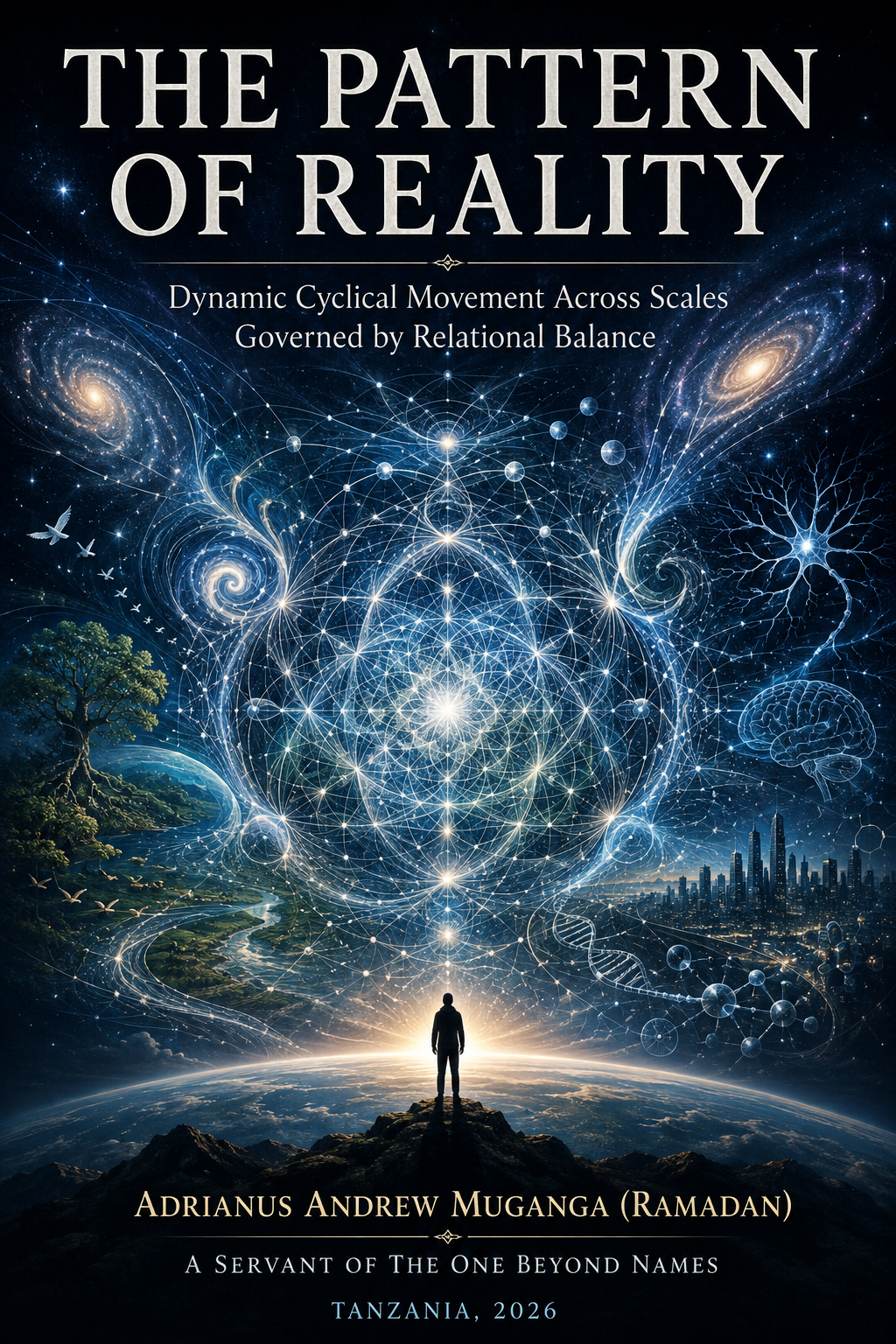
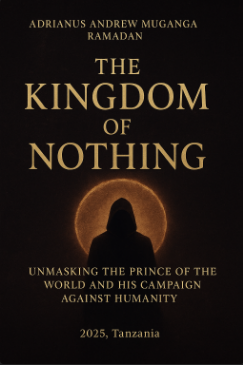
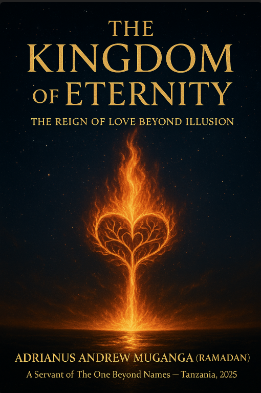
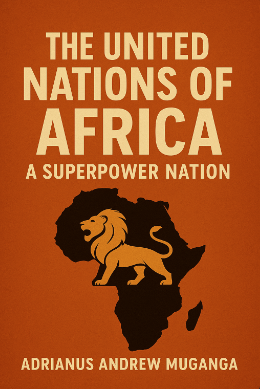
"THE PATTERN OF REALITY: Dynamic Cyclical Movement Across Scales Governed by Relational Balance" is a large-scale interdisciplinary philosophical and civilizational work that examines the deeper structural patterns governing existence, consciousness, ecological systems, civilization, psychology, science, and the future of humanity. Written by Adrianus Andrew Muganga, the work proposes a central ontological framework grounded in the observation that reality does not fundamentally operate through isolated static entities, rigid separation, or permanent forms. Instead, reality functions through continuous relational movement, adaptive balance, cyclical transformation, interdependence, emergence, and structural consequence across scales of existence.
The work begins by challenging one of the most deeply embedded assumptions within modern civilization: the perception that reality is fundamentally fragmented into separate domains such as science, religion, politics, economics, psychology, ecology, philosophy, and technology. According to the framework developed throughout the book, fragmentation exists primarily within human perception, institutional organization, and conceptual systems rather than within reality itself. Reality continues operating relationally regardless of how human beings categorize or interpret it. Biological systems remain dependent upon ecological conditions. Civilizations remain dependent upon psychological regulation, resource balance, cooperation, and adaptive stability. Consciousness emerges relationally through interaction between biological, environmental, emotional, social, and structural conditions. Ecological systems continue responding to imbalance regardless of political ideology or economic preference.
The central argument of the work is that many contemporary global crises are not isolated failures emerging independently from one another, but interconnected manifestations of deeper structural imbalance accumulating simultaneously across systems. Ecological destabilization, climate disruption, psychological fragmentation, compulsive consumption, technological acceleration without ethical maturity, political polarization, social distrust, meaning collapse, civilizational exhaustion, and widespread psychological suffering are examined as relational consequences emerging from fragmentation across scales. The book argues that humanity has achieved extraordinary technological capability while remaining deeply immature in psychological regulation, ecological responsibility, structural awareness, and long-term civilizational coherence.
The framework developed throughout the book approaches reality primarily through process rather than static substance. Existence is examined as continuous movement and transformation rather than permanent fixed identity. Stability itself is redefined not as immobility or rigid permanence, but as adaptive regulation capable of maintaining coherence under changing conditions. Systems survive not because they remain unchanged, but because they adapt while preserving functional continuity. Collapse is similarly approached not as moral punishment or isolated catastrophe, but as structural consequence arising when imbalance accumulates beyond adaptive limits.
One of the foundational themes explored throughout the work is the relationship between balance and fragmentation. Balance is described not as perfect symmetry or absence of tension, but as sustainable relational coherence between interacting systems and processes. Fragmentation emerges when integration weakens and systems lose adaptive coordination across scales. The book repeatedly demonstrates how imbalance within one domain eventually generates instability throughout interconnected structures. Psychological fragmentation contributes to social instability. Ecological destruction generates economic and civilizational vulnerability. Technological acceleration without ethical maturity destabilizes collective consciousness. Civilizations disconnected from ecological and psychological reality eventually experience structural collapse.
The work also explores consciousness as relational process rather than isolated independent identity. Human consciousness is approached as an emergent phenomenon shaped continuously through interaction with memory, emotion, biology, social structures, environment, symbolic systems, technology, and collective conditions. Psychological suffering is examined structurally rather than merely individually. Fear, addiction, compulsive behavior, emotional dysregulation, ideological rigidity, escapism, and trauma are explored as expressions of fragmentation and imbalance within both individuals and societies. Healing is described not as perfection, but as reintegration and restoration of adaptive coherence.
A major section of the book investigates the rise of fragmented perception throughout human history. Earlier civilizations often approached existence more holistically because survival itself required awareness of interdependence across systems. Over time, however, increasing specialization divided knowledge into separate intellectual territories. Science, philosophy, religion, economics, psychology, politics, and ecology gradually became isolated domains competing for authority over reality rather than complementary modes of observation. Symbolic systems that once functioned as interpretive tools increasingly hardened into rigid ideological structures. Humanity became progressively conditioned to mistake symbols, concepts, models, and institutional frameworks for reality itself.
The work argues that many ancient traditions, philosophical systems, scientific discoveries, and symbolic narratives may have been observing overlapping structural dynamics through different conceptual languages. Although interpretations differed across cultures and historical periods, recurring patterns repeatedly emerged concerning balance, instability, adaptation, emergence, transformation, collapse, continuity, and relational consequence. The book therefore attempts to move beneath ideological and symbolic attachment toward direct structural observation of recurring patterns operating across systems and scales.
Another major dimension of the work focuses on civilization as living system. Civilizations are examined not merely as political entities, but as dynamic structures dependent upon psychological health, ecological sustainability, cooperation, resource distribution, adaptive regulation, social trust, and long-term balance. The book argues that modern civilization increasingly operates through extraction, acceleration, overstimulation, consumption, and short-term expansion while neglecting the deeper structural conditions required for continuity. Technological power has expanded faster than ethical maturity. Economic growth has often become detached from ecological sustainability. Political systems increasingly reward polarization rather than coherence. Information systems amplify fragmentation, distraction, and psychological instability. Humanity therefore stands at a civilizational threshold where the future of continuity may depend upon whether deeper structural recognition develops before instability accelerates beyond adaptive recovery.
Throughout the work, science, philosophy, ecology, psychology, cosmology, systems theory, and historical observation are brought into interdisciplinary relationship. The book explores thermodynamics, emergence, systems stability, ecological feedback, cosmological cycles, neuroscience, consciousness studies, complexity theory, and process philosophy as interconnected approaches toward understanding relational existence. Rather than rejecting science or spirituality, the work attempts to examine whether deeper structural continuity remains visible beneath fragmented intellectual divisions.
The final sections of the book focus on the possibility of civilizational healing and the return to structural coherence. The framework proposes that long-term human continuity may increasingly require educational transformation, ecological responsibility, psychological maturity, ethical technological development, sustainable economics, balanced leadership, and renewed awareness of humanity’s participation within larger relational systems. The work emphasizes that reality itself does not require human belief in order to function. Structural consequence continues regardless of ideology, denial, or symbolic attachment. Truth remains independent of preference.
At its deepest level, *THE PATTERN OF REALITY* is not written to create followers, defend institutions, preserve ideology, or establish metaphysical certainty. It is written as an observational framework intended to encourage recognition. The book asks whether recurring patterns concerning balance, movement, transformation, fragmentation, adaptation, collapse, and continuity remain consistently visible across consciousness, ecosystems, civilizations, cosmology, biological systems, and human experience itself. It argues that humanity’s future may increasingly depend upon the capacity to recognize reality structurally rather than continue living through fragmentation, denial, and unsustainable imbalance.
#Reality
#Consciousness
#Civilization
#Systems Theory
#Relational Balance
#Philosophy
#Ontology
#Ecology
#Human Existence
#Psychological Fragmentation
#Civilizational Collapse
#Systems Thinking
#Metaphysics
#Interdependence
#Transformation
#Emergence
#Process Philosophy
#Structural Reality
#Future Humanity
#Global Crisis
#Adaptive Balance
#Consciousness Studies
#Ecological Systems
#Philosophical Framework
#Societal Transformation
#Complexity Theory
#Human Continuity
#Structural Patterns
#Civilization And Consciousness
#Dynamic Systems
#Existential Philosophy
#Holistic Understanding
#Cosmology
#Sustainability
#Collective Psychology
#Relational Dynamics
#Human Future
#Integrated Systems
#Modern Civilization
#Structural Ontology
#Interdisciplinary Philosophy
#Balance And Collapse
#Systemic Instability
#Ecological Balance
#Social Fragmentation
#Reality And Perception
#Philosophy Of Existence
#Global Systems
#Consciousness And Reality
#Future Civilization