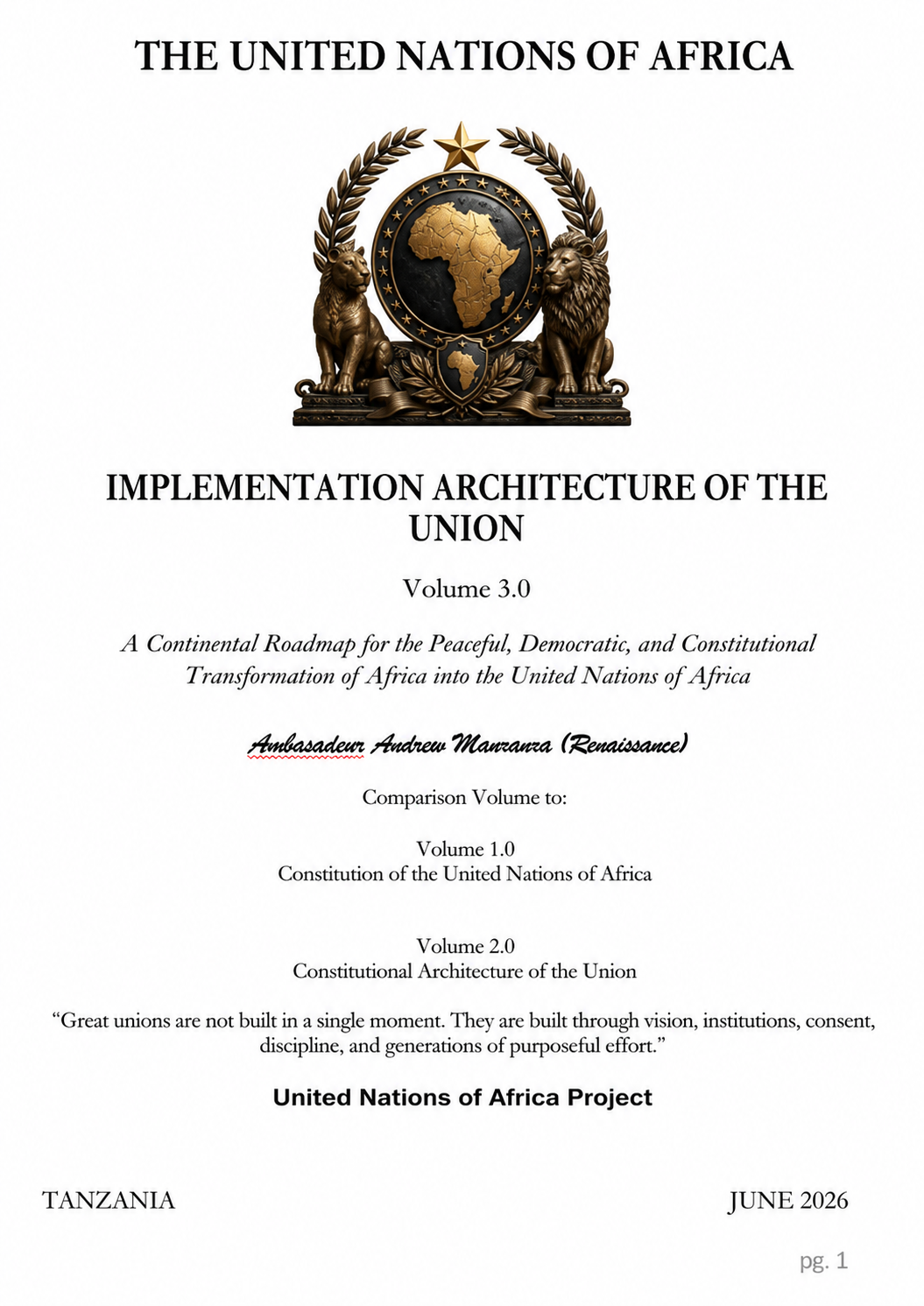
Implementation Architecture of the Union is the third volume of the United Nations of Africa Constitutional Development Series, a comprehensive scholarly project dedicated to developing a constitutional, institutional, legal, political, and governance framework for the proposed United Nations of Africa. While the preceding volumes establish the constitutional foundations and institutional architecture of the Union, this volume addresses the most important practical question of all: How can such a Union actually be implemented?
For generations, discussions surrounding African unity have been dominated by aspirations, declarations, and political vision. Although these discussions have inspired continental cooperation, they have often stopped short of providing a realistic implementation strategy. This book fills that gap by presenting a complete constitutional and institutional roadmap through which a continental union could be established peacefully, democratically, lawfully, and financially sustainably. It transforms the debate from one of aspiration to one of implementation.
At the heart of the book lies a simple but powerful proposition: Africa does not need to build an entirely new continent. It already possesses governments, constitutions, legislatures, courts, civil services, universities, financial institutions, infrastructure, regional organizations, economic communities, and the institutions of the African Union. Rather than replacing these structures, the implementation process should focus on transforming, coordinating, harmonizing, and integrating them into a coherent continental constitutional order. The principal challenge is therefore not institutional creation but institutional transformation.
The volume rejects revolutionary political change and instead advances an evolutionary constitutional model founded upon democratic legitimacy, constitutional continuity, gradual implementation, subsidiarity, respect for national sovereignty, and long-term institutional stability. Every proposed stage of implementation is designed to proceed through lawful constitutional processes, democratic consent, and the voluntary participation of Member States. The book argues that enduring continental institutions can only be established through constitutional legitimacy rather than political coercion.
The implementation framework is organized into eleven comprehensive Parts comprising seventy chapters, each addressing a distinct dimension of continental transformation. The opening chapters establish the practical case for implementation by examining Africa's existing institutions, infrastructure, economic capacity, human capital, governance systems, and strategic opportunities. These chapters demonstrate that the necessary foundations for deeper integration already exist throughout the continent and that implementation should be viewed as a process of organized development rather than institutional invention.
Building upon this foundation, the book develops the constitutional principles that guide the entire implementation process. These include democratic legitimacy, constitutional supremacy, federalism, separation of powers, subsidiarity, institutional accountability, fiscal sustainability, peaceful transition, and the preservation of existing national institutions wherever possible. Together, these principles create a constitutional philosophy that balances continental integration with the continued importance of sovereign Member States.
A major contribution of the volume is its detailed treatment of constitutional transition. Rather than assuming that a continental union can emerge immediately, the book proposes carefully sequenced phases through which authority is progressively transferred from existing institutions to newly established Union institutions. Transitional arrangements are designed to minimize disruption, preserve governmental continuity, maintain legal certainty, and ensure that public services continue uninterrupted throughout the implementation period.
The volume also presents comprehensive institutional blueprints for the transformation of executive, legislative, judicial, and administrative structures. It explains how continental institutions can evolve from existing African Union organs while preserving constitutional accountability, democratic representation, judicial independence, and administrative professionalism. Particular attention is given to balancing continental authority with the constitutional autonomy of Member States through clearly defined divisions of power and shared governance.
Financial sustainability receives equally detailed treatment. The book recognizes that no constitutional union can endure without reliable financial foundations. It therefore develops mechanisms for phased revenue generation, fiscal responsibility, budgetary accountability, institutional financing, and long-term economic sustainability. Rather than depending indefinitely on external assistance, the proposed implementation architecture seeks to establish financial independence through constitutional fiscal institutions capable of supporting continental governance across generations.
Implementation is further supported by extensive analysis of public administration, civil service integration, infrastructure coordination, legal harmonization, regulatory convergence, digital governance, institutional capacity-building, and intergovernmental cooperation. The volume demonstrates how existing administrative systems can gradually evolve into an integrated continental governance framework while preserving operational continuity and respecting national constitutional traditions.
Recognizing that institutional transformation requires measurable progress, the book establishes implementation benchmarks, performance indicators, evaluation mechanisms, and constitutional review procedures to guide each stage of transition. These mechanisms provide objective criteria for determining readiness before additional constitutional powers are transferred to continental institutions, ensuring that implementation proceeds according to demonstrated capacity rather than political expediency.
The concluding sections address long-term constitutional continuity and the preservation of the Union across future generations. The book argues that successful constitutional systems depend not only upon sound institutional design but also upon mechanisms capable of protecting democratic governance, constitutional stability, judicial independence, and institutional resilience over time. Accordingly, it proposes safeguards that enable the constitutional order to adapt peacefully while preserving its foundational principles.
Beyond its specific proposals for African integration, Implementation Architecture of the Union contributes more broadly to constitutional law, comparative federalism, institutional design, governance studies, public administration, regional integration, political science, and long-term statecraft. It offers an original model for the peaceful constitutional transformation of a continent-scale political union while demonstrating how democratic legitimacy, constitutional order, institutional continuity, and strategic planning can operate together within a comprehensive implementation framework.
This volume is intended for constitutional scholars, judges, lawyers, policymakers, legislators, public administrators, political scientists, researchers, students, diplomats, regional organizations, and everyone interested in the future of African governance and constitutional development. It also serves as a practical reference for those studying federal systems, constitutional transitions, institutional reform, and regional integration across the world.
Ultimately, Implementation Architecture of the Union demonstrates that continental union need not remain an abstract political aspiration. Through constitutional design, institutional transformation, democratic participation, financial sustainability, and long-term strategic planning, it presents a practical roadmap by which the United Nations of Africa could evolve from constitutional vision into institutional reality. In doing so, the book seeks not merely to imagine Africa's future, but to provide a lawful, peaceful, and implementable pathway through which future generations, if they so choose, may build it.
#Constitutional Law
#Comparative Constitutionalism
#Federalism
#African Integration
#Pan-Africanism
#Governance
#Public Administration
#Democratic Institutions
#Statecraft
#Political Economy
#Regional Integration
#International Law
#Institutional Design
#Constitutional Engineering
#Peacebuilding
#Sustainable Development
#Strategic Studies
#Public Policy
#Civilizational Studies
#Nation Building













![The Nu African Calendar [Volume One] book by Dia Mari-Jata](https://xania.goelway.com/assets/books/frontcoverimgs/NU AFRICAN BOOK COVER VOL 1 FRONT_ebookfrontcover.JPG)